Children's Health: The Enchanted Hospital
 |
| The All Ukrainian Health Protection Centre for Mothers and Children will be partially built into the landscape |
The natural forest habitat has been embraced in the concept for the new All Ukrainian Health Protection Centre for Mothers and Children in Kiev, which is intended to delight and inspire the imagination of its patient group, writes Neil Cadenhead.
Modern hospitals invest heavily in supporting clinical efficiency and patient comfort, meeting Vitruvius’ standards of ‘firmness’ and ‘commodity’, but often come up short in ‘delight’ – the third of his prerequisites for good design. By employing the following design principles, the concept for the All Ukrainian Health Protection Centre for Mothers and Children in Kiev aims to not only deliver optimum levels of ‘efficiency’ and ‘comfort’ but also seeks to provide meaning, cultural relevance and to engage the imagination of children.
Anthropomorphic
Since the dawn of time, architecture has sought to express the form and proportions of the ideal human. This design extends this concept by taking the most humble of forest life – insects, leaves, sticks and rocks – to stimulate the child’s imagination through the form of a building that sits naturally in its landscape, is reassuring and, at the same time, adventurous.
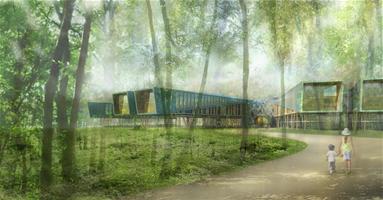 |
The forest setting creates a welcoming approach for patients and visitors
|
A response to the forest
Developed on a stunning site, the design aims to respect and work with the forest to preserve its unique atmosphere, rather than destroy it. By seeking to remove as few trees as possible and develop a landscape design that uses the natural forest floor rather than grass as its base, the architecture harmonises with the forms, feeling and colours of the forest.
By also employing natural ventilation during spring and autumn, which allows windows to be open and the smell of fresh air and the sound of birdsong to penetrate, the natural habitat is maintained and a more powerful cultivation of the healing environment is made possible.
Local context
The adoption of a uniquely Ukrainian approach to the architecture embeds the design in local culture, thereby avoiding the normal ‘clothing’ worn by so-called international designs – aluminium, curtain glazing and simple rectangular forms.
The design seeks instead to give a modern reinterpretation of the precedents, expression and form of the Ukrainian landscape, its people, its vernacular buildings and the forest itself.
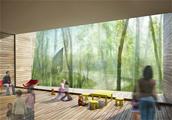 |
The transparent design creates the feeling of being in amongst the trees
|
A place for children
Reassuring and accessible for children, the design is also suggestive in its response to the joy of childhood, in particular to play, fantasy and another world full of mythical beasts, fairies, and magic. But children are seldom alone in hospital.
Recognising that a parent or guardian accompanies them during their stay, bedrooms are ‘family’ rooms, and the building offers positive distraction to worried carers. All bedrooms are single occupancy, but with additional space for a reclining chair or folding bed for relatives.
Young children have difficulty comprehending the idea of illness. Treatment is often observed by children to be ‘scary’ and associated with pain. By separating areas of treatment and diagnosis, physically and visibly, the design aims to disconnect the children from negative associations and memories with the rooms and spaces such as ward areas inhabited during recovery and rest.
Design statement
In most hospitals, on arrival at the main entrance, patients are led through treatment and diagnostic areas in a celebration of its functional purpose. In the architecture of this hospital, the ‘technical platform’ has been ‘lost’ in the landscape, allowing the patient to approach the building from the aspect of the bedroom, thereby providing reassurance about their lodgings and habitat.
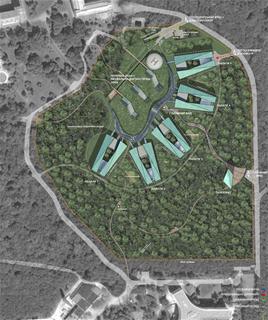 |
Paths lead to the hospital's main entrance and to the two other hospitals on the campus
|
There is also considerable research to show that positive distraction from illness and pain aids the speed of recovery by lowering the patient’s perception of pain. The aim of this design, therefore, is to make the internal environment of the ward blocks reassuring and homely.
But comfort has both a physical and psychological perspective. The criteria for physical comfort in all patient groups include correct temperature, relief from strong sunlight penetration of the building, and quiet. But children, in particular, are psychologically sensitive to the environment and require opportunities for intellectual stimulation, play and learning that are typically available outside and need to be replicated in the hospital setting.
The child’s needs in hospital go beyond the need for physical and psychological comfort, embracing the whole of Maslow’s hierarchy of needs: safety, belonging, esteem and self-actualisation. The design response, to plan for 100% single bedrooms, enables the bedroom to become a refuge and a home for the duration of the child’s stay.
The connection between the hospital interior and the forest is critical too, ensuring the building affords a transparent view to the outside world, so that patients enjoy a feeling of being ‘among the trees’, with all the associations of comfort and safety inherent in nature. Spiritually the buildings define a ‘clearing in the trees’, thereby creating a welcoming space for visitors and patients on arrival. From this space, paths lead to the hospital’s main entrance and beyond to the other two hospitals on the campus. The system of walks in and around the children’s hospital becomes part of the existing system of forest walks to be enjoyed by the patients from all three hospitals.
The principal space of the hospital is a long sinuous atrium space, which encloses all the main public areas and circulation routes of the hospital. It is roofed with ETFE bubbles, and framed by a hexagonal structure, to create a form redolent of an insect’s eye. This form of roof is transparent yet highly insulated, easily maintained, inexpensive and easy to construct. The atrium wraps around the technical platform to provide easy access to all treatment, diagnostic and consulting spaces.
The clinical corridors are not shared by the public and are formed of fritted glass tubes which leave the technical platform and punch out through the atrium wall to link to the ward blocks. The pattern of corridors is dendritic in character, so that each of the wards is at the end of a finger, ‘sheltered’ from passing traffic.
The building has a main entrance expressed as a golden shell and secondary, more functional entrances, including an emergency entrance to the side of the building, with a dedicated approach road for ambulances; a helicopter pad located at the rear of the technical platform, providing rapid access to the theatres and critical care units; and a stores and supplies entrance, concealed from view at the rear of the facility.
 |
|
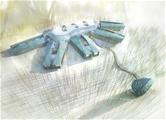
The connection to nature is integral to the design of the building
|
Sustainability
The Kiev climate is cold and dry in the winter, with conditions of -25ºC @ 90% relative humidity (RH) and hot and dry in the summer with conditions of 35ºC with 75%RH in the morning and 55%RH in the afternoon. People in naturally ventilated spaces are comfortable in a greater range of temperatures than in fully air-conditioned spaces – which in itself is an energy-saving measure. This psychological phenomenon also applies where people can control their own environmental conditions.
The result is that the developed world is moving away from fully air-conditioned hospitals in favour of passive, as opposed to active, buildings that naturally maintain comfortable conditions. This approach is adopted in the design which incorporates features such as: a high thermal mass of the technical platform; and by contrast ventilated bedroom pods; with ward windows shaded from the sun for summer; and an atrium ‘winter garden’.
These initiatives are intended to produce a more natural type of comfort in the building as part of a strategy to save energy and limit CO2 emissions with an objective to reduce the annual energy consumption.
In Kiev, as in the rest of the world there is a need to address long term shortages in energy supply and to try to arrest climate change. To achieve this, our strategy is to minimise the building’s energy demand and to incorporate energy saving and low carbon renewable technologies.
The building’s use of energy will be minimised by the following conservation and renewable energy proposals:
• The engineering service strategy has been developed with a view to achieving exemplary status in terms of carbon emissions. Natural gas tri-generation system incorporating duel fuel boilers (complete with condensing option), combined heat and power and absorption chillers will be provided as the primary source of electrical and thermal energy.
• Chilled beams have been selected as the primary means of space cooling, with the potential for linking to a ground loop. The project will also feature solar thermal panels for hot water. Grey water recycling will be used for toilet flushing.
Only a research-based evaluation over time of the design of the All Ukrainian Health Protection Centre for Mothers and Children in Kiev will establish whether it has been a success or failure. What is without doubt is that the design attempts to raise the game in terms of design quality standards.
It poses the challenge that, in the future, just prioritising functional efficiency and patient comfort will not suffice. Healthcare environments should entertain the imagination, be of their place and time and, ultimately, offer delight.
Neil Cadenhead is a director of bdpgroupe6
|

1.1.jpg)


|