South America: Southern symmetry
Keen to tap into the latest research and innovation, Latin America looks north for new partnerships while retaining a distinct regional flavour, writes Emily Brooks.
|
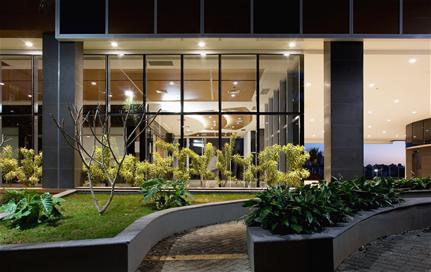
Hospital Universitario San Vicente de Paul's, Colombia, welcoming reception lobby
|
Two prestigious gatherings in South America this November will promote the region’s healthcare to a world audience – the International Hospital Federation’s 36th World Congress in Rio de Janeiro (the first in its history to be held in a Latin American country) and the International Union of Architects (IUA) Public Health Seminar in Buenos Aires. As with any such event, the host nations are eager to show off those areas of healthcare in which they excel. But what’s the overall picture for a continent that straddles the developed and the still-developing, and experiences high levels of inequality, despite the promise of swift economic growth?
It’s easy to see the thinking behind the decision to make Brazil the focus for the IHF’s congress. As South America’s most populous country, with its highest GDP by some margin, it is one of the four ‘BRIC’ nations (along with Russia, India and China) that in 2001 Goldman Sachs famously identified as having exceptional growth potential. It is also a country where hospitals play a central part in healthcare policy, absorbing 70 per cent of Government health spending1.
 |
| Pedestrian entrance of Sao Paulo's Hospital Israelita Albert Einstein in Brazil |
There are 19 JCI-accredited facilities and programmes here, which are jointly accredited with the Consortium for Brazilian Accreditation. These include the prestigious Hospital Israelita Albert Einstein (HIAE) in São Paulo, which has just opened a 16-storey, 750,000 sq ft new outpatient building that is part of a wider masterplan conceived by Kahn, a practice that has had a Brazilian outpost since 1998.
Outpatient buildings are relatively rare in Brazil, where medical offices are usually incorporated within a centralised hospital building.
Its high-rise design is a typical response to the realities of building in dense urban environments; its sustainability measures (such as its rooftop park) and anticipated LEED certification, are less than typical for the region.
 |
Hospital Israelita Albert Einstein, São Paulo, Brazil
Project completion: 2009
Client: Hospital Israelita Albert Einstein
Architect: Kahn do Brasil / Albert Kahn Associates
Size: 750,000 sq ft (69,677sqm)
Construction cost: US$120m |
For all this, however, HIAE remains the exception rather than the norm. “A few hospitals are world-class centres of excellence; they serve the minority, the well-off,” asserts a recent World Bank report1. “‘Substandard’ best describes most hospitals, the ones serving Brazilians who cannot pay out of pocket or afford private insurance. These hospitals, many dependent on public financing, deliver inefficient, poor-quality care, judging from the available data.”
The World Bank’s assessment serves as a stark reminder that Latin America is still a developing region, suffering from many of the same health problems that affect similar regions. The Pan American Health Organization’s (PAHO) latest review of its territory2 notes that: “During the past decade, and in good measure due to the growing permeability of transnational borders, diseases once thought to have been brought under control – such as tuberculosis, malaria, dengue, plague, yellow fever – have been reappearing, while relatively new communicable diseases – such as HIV/AIDS, SARS, and more recently, West Nile fever and the new variant of avian influenza (H5N1) – are emerging as major health threats.”2
|
Hospital Universitario San Vicente de Paúl,
Rionegro, Colombia
Already a 95-year-old Medellin establishment, the university’s new facility in Rio Negro is influenced by US trends, such as its use of intuitive wayfinding and the influence of retail design in allowing each of the clinic buildings to have its own storefront. Evidence-based design was also used, explains Marlene Liriano, principal and interior design director at Perkins+Will’s Miami office: “The hospital directors wanted a highly efficient facility while assisting staff to provide the highest level of care with the lowest risk of errors,” she says. “With that in mind, all patient rooms are single-handed to avoid potential mistakes.” Flexibility and adaptability were key criteria requested by the hospital, and major components were designed in modules so that the campus could grow incrementally. Perkins+Will is working with a Colombian architecture practice, Condisegno, to realise this project. |
PAHO also identifies high inequality as the chief barrier to the availability of good healthcare for all – nearly 35 per cent of the region’s population live in poverty, and 22 per cent do not have access to health services3.
At the same time, those countries that have experienced rapid economic growth, such as Brazil and Chile, are facing health issues reflective of a more developed society, including chronic and degenerative diseases and accidents and injuries.
The growing incidence of cancer, for example, has recently led to launch by two North American bodies (the National Cancer Institute (NIC) and the National Institutes of Health (NIH)) of the new Office of Latin American Cancer Program Development. The programme’s initial focus is on Mexico, Brazil, Chile, Argentina and Uruguay; it aims to gain a better understanding of the cancer burden in these countries as well their capacity for research and treatment.
In line with other developing regions, increased expenditure and a commitment to healthcare reform is widespread.
Decentralisation and the introduction of health insurance are the main features of this reform. In Chile, for example, mandatory health insurance means that more than 80 per cent of the population has public insurance, while the remainder are with private insurers4. In a recent poll, more than 91 per cent of Uruguayans said they were financially covered for hospitalisation, whether by public programmes, private health insurance or the social security system4. As the provision of social security spreads, however, it is expected that governments will be unlikely to have enough resources to meet demand, and that more private hospitals will be built as a result.
In many countries, the healthcare market is very sophisticated and private care is world-class. Doctors are often trained in North America or Europe and return with a progressive and global outlook on clinical matters as well as the way hospitals are built and run. “In Mexico there are no architectural firms geared solely towards healthcare design, so our clients rely a lot on our expertise as planners to lead them through the effort,” says HKS’s Enrique Greenwell, lead designer on a number of recent projects for the American British Cowdray (ABC) Hospital in Mexico City.
|
American British Cowdray (ABC) Neurology Center, Mexico City
Project completion date: 2011
Client: American British Cowdray Medical Center
Architects: HKS
Project cost: US$31m including parking garage
Size: 185,000 sq ft (17,187sqm)
Number of beds: 100 |
HKS was asked to complete two new projects for its Santa Fe campus, a women’s and children’s centre, which opened in January 2008, and a neurology centre, construction of which is about to begin (see case study). “I’ve always said that these are site-driven designs,” says Greenwell. “The problem we faced with the women’s centre as well as the neurosciences centre is that they’re landlocked in a very developed area, with parking areas in front of the hospital – and they are pretty much perched on top of a hill, so you have to have drives that lead up to them.”
These large areas of hard landscaping were at odds with HKS’s philosophy of allowing widespread access to the natural environment. An additional issue was building something in keeping with the existing hospital, which consisted of two very different-looking structures – one covered in hammered metal panels, the other in glass. The women’s centre’s curving form links the two: glass on one side (low-e, and with solar shading, both to minimise solar gain) and metal on the other (this time in a smooth finish rather than hammered, so it needs cleaning less frequently). Having moved much of the parking underground, HKS created a ‘green belt’ at the exterior using low-maintenance native plants and made sure than green areas, rather than hot concrete, were visible from patients’ rooms.
|
American British Cowdray (ABC) Neurology Center, Mexico City
The new neurology centre on the Santa Fe campus responds to
the curving form of the HKS-designed women’s and children’s
centre, and uses similar building materials including composite metal panels and locally quarried marble. Planting on a series of balconies and terraces gives access to nature and protects southfacing windows from the harsh sun. Inside, the needs of neurological patients are kept in mind: “When a patient or family goes here, they are going through some harsh moments, and family want to be with the patient as long as they can,” says HKS’s Enrique Greenwell, lead architect for the project. “A patient that has a neurological problem can sometimes barely walk, so they have a hard time moving from one space to the next. So the idea is to bring as much natural light into the space and to create wide welcoming spaces, with as few walls as possible.” |
From a business perspective, having a local base appears to be key to securing and maintaining clients. HKS has a new office in Miami as well as an established outpost in Mexico City that Greenwell says is “probably one of our smaller offices but one that has worked steadily for the past seven years. We have a lot of work in that area of the world and we believe it is a growing market. It’s working for us.” HKS was recently awarded the design of Puerto Rico’s Guaynabo City Hospital, a pioneering public-private partnership venture that will result in the country’s first all-private-room hospital.
Kahn sees its HIAE project as the marriage of two strands of expertise – with knowledge of local customs and building regulations coming from its São Paulo office while the latest research, innovation and specialist design knowledge feed in from its North American offices in Detroit and Birmingham.
Meanwhile, Perkins+Will worked in conjunction with a local architect, Condisegno, for its latest project in Colombia, the Hospital Universitario San Vicente de Paúl in Rionegro (see case study). “We have found that most local architects have limited knowledge or expertise in the healthcare market,” says Marlene Liriano, principal and interior design director at the firm’s Miami office, from where it oversees its Latin American interests. Having successfully collaborated on this project, Perkins+Will is exploring further opportunities with Condisegno in Colombia.
|
Hospital Universitario San Vicente de Paúl, Rionegro, Colombia
Project completion date: 2011
Client: Hospital Universitario San Vicente de Paúl, Medellin, Colombia
Architects: Perkins+Will
Condisegno, SA (local associate architect)
Size: 540,000 sq ft (50,168sqm)
Number of beds: 260 |
Alice Liang, design principal at Montgomery Sisam in Toronto, offers a different picture of Latin American countries’ willingness to work with overseas architecture firms – at least in Argentina, where she has spent time promoting Montgomery Sisam’s work as well as visiting hospitals for her own research. “I have sensed that, in Argentina, there is not a trend yet to engage specialists from abroad for joint venture,” Liang says. The prolonged economic challenges mean that “whatever work there is remains with the locals”.
|
|
Hospital Universitario in Guenca in Ecuador,
designed to allow for future growth
|
Ecuador offers a recent example of this practice. Hospital Universitario del Río (HUR), a new private facility in Cuenca, was designed by Ecuadorian architect Xavier Corral. He travelled extensively in Colombia and the US to research the building of this international-standard hospital. “One of the main differences when compared to other local and national institutions is that it was built from zero in a terrain large enough to accommodate future growth,” says the hospital’s CEO, Dr Diego Castresana. “This hasn’t happened elsewhere because hospitals mainly expand their facilities by purchasing the next-door building – along with all the problems it encompasses.”
HUR’s administration and management are outsourced to a US firm, the American Hospital Management Company (AHMC) – another way in which North America is influencing healthcare south of the border. The partnership removes some of the isolation that can occur with single private hospitals, says Castrasana: “Because of the relationship AHMC has with hospitals across Latin America and other countries, we are constantly gathering information regarding performance that benefits all the hospitals in the network.”
Crucially, it also lends an air of financial stability to the project: “Because of AHMC, private investors see HUR as a safer environment.”
Emily Brooks is an architectural writer
References
1. La Forgia GM, Couttolenc BF. Hospital Performance in Brazil: The Search for Excellence, En Breve 120, March 2008; 1:20.
2. Pan-American Health Organization. Health in the Americas. Washington DC: PAHO; 2007.
3. World Bank. Health, nutrition and population brief: Progress In health In the Latin America and Caribbean region. Available online at www.worldbank.org
4. Savedoff WD. A moving target: Universal access to healthcare services in Latin America and the Caribbean, Inter-American Development Bank, paper no 667, January 2009
|

1.1.jpg)







|