Design guidance: Smarter PFI
 |
|
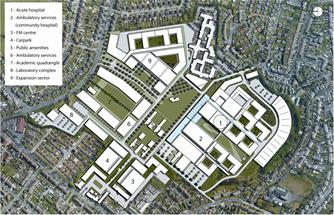
North Bristol NHS Trust site plan
|
Ken Schwarz describes how North Bristol NHS Trust adopted a new affordable and effective way to provide clear design guidance to PFI bidders on the redevelopment of the Southmead Hospital.
From its inception, the Private Financial Initiative (PFI) for developing healthcare facilities has been controversial. Its advocates claim that many of the 200 projects completed over the last decade in the UK would not have been implemented without PFI.
They say the private sector has contributed strong management, a high level of cost and schedule certainty, along with the assumption of risk and the investment of private capital in needed public works. They contend that the range of private-sector experience assembled for PFI work brought international best practice to what had become an inward looking and tired NHS approach to the planning and design of healthcare facilities.
Others argue that the product of the decade-long PFI effort has fallen short of its potential to deliver world-leading healthcare facilities, claiming that PFI has delivered facilities that are “fit-for-purpose and offer value for money” only by the most generous interpretation.
Exhibit 3 confirms that these weaknesses are widely recognised, even by its government sponsors. Layer upon layer of remedies for the shortcomings of the PFI programme have been proposed. Each year brings forth a new approach, such as the recently adopted use of design exemplars and competitive dialogue.
The Royal Institute of British Architects (RIBA) and the UK government’s design watchdog, the Commission for Architecture and the Built Environment (CABE), have entered the fray, convinced that the answer is to separate the designer’s work from the bidding for management, finance, construction and operational aspects of project development – thereby reaffirming the client/architect relationship that is at the core of most successful design efforts and is often lost in PFI.
They cite the efforts of John Cole, director of the Health Estates Agency for Northern Ireland, where he has commissioned skilled planning and design teams to work directly with hospital trusts to create well-developed design exemplars that serve as the basis for subsequent bidding by PFI consortia. In the UK this method is championed as a ‘Smart PFI’.
Our experience at Bristol
Approximately a year ago, NBBJ, as part of a larger technical team led by Integrated Building Services, was engaged to advise the North Bristol NHS Trust in the rebuilding of the £400+m Southmead Hospital site via PFI. The trust had high aspirations to achieve efficiencies by consolidating the services of two hospitals onto one site – as well as achieving a high quality facility and environment for care. The trust hired David Powell to lead the development team – a veteran of successful PFI projects who brought an additional thrust for excellence.
Powell assembled a knowledgeable and energetic project team, including directors of the medical and nursing staff along with experts in management, finance, estate and contracts. Importantly, Sonia Mills, chair of the trust, volunteered to be design champion, thereby reinforcing the trust’s ambition. This quest was further reflected in the selection of technical advisors from the private sector and design advisors from CABE, the Department of Health Design Review Panel and Bristol City town planners. This formidable array of talent and resource not only strengthened the trust’s team, but also signaled that for this PFI “design and quality mattered”.
The protocols and guidance from the government’s Private Finance Unit (PFU) left the trust team latitude as to which process it would follow to achieve its objectives. These ranged from defining the project requirements in terms of performance outcomes “to elicit the maximum range of response and innovation from the private-sector bidders”, to the more proscriptive design exemplar approach.
The project team discarded the former method, given its history of being difficult to assess – and often producing results that favoured consortia interests rather than trust needs. Although the design exemplar method looked promising, produced good results in Northern Ireland and received support from design-orientated groups, it faced major obstacles to use at Bristol – the cost of developing the exemplar was prohibitive and, unlike in Northern Ireland, would not be reimbursed by the government; and a survey of potential bidders revealed that they uniformly opposed the approach, claiming that it would limit the innovation and unique selling points they could bring to their bids.
Therefore, the project team chose a third path for the Bristol PFI, which was less proscriptive and expensive to develop than a full design exemplar, but sufficiently descriptive to clearly set forth the trust’s quantitative and qualitative objectives. In particular, the body of information made available to bidders would be enhanced to describe the more elusive aspects of the trust’s aspirations – those that define design excellence and high quality.
Part of this guidance was presented in a summary of the project team’s observations of existing healthcare and other environments titled, What the trust likes, and doesn’t like. Part of this guidance was more formally summarised by the design advisors through close working with the project team. The result is an affordable and effective way to provide clear design guidance to PFI bidders.
Dubbed “Smarter PFI” by the trade press, the following summarises key elements of this guidance.
Long Range Development Plan (1:1250)
The LRDP established a framework to guide the future development of the 27-hectare Southmead Hospital Campus. The plan indicated zoning, type and scale of development, roads and parking and best use of valued existing buildings and landscape. It also embodied urban design principles related to place making, public and private space, consideration of historic patterns of development, and neighbourhood interface and regeneration. This plan was developed in close working with the Bristol City town planners. (Exhibit 1 and 2)
Development Control Plan (1:1250)
The principles of the LRDP were more fully tested in the specific 10-hectare zone established within the campus for the PFI project. The DCP also described the measures required to prepare the site for the project, which resulted in £50m of enabling works being carried out in advance.
Public Sector Comparator
In the manner that the LRDP and DCP defined and tested objectives for site development, the Public Sector Comparator did so for the proposed buildings. The PSC resulted from the studies described below. Taken together, they embody the trust’s quantitative and qualitative requirements for the project.
Building Concept Diagram
The sketch diagram, embodies three important design concepts that underpin the PSC: the separation of high-tech, process-driven functions (diagnostics and treatment) from the low-tech, patient-focused functions (wards) – thereby enabling each to respond most efficiently to its functional requirements, whilst ensuring easy flow between them; the creation of a low-rise hospital complex, interspersed with green spaces, thereby maximising the contribution of natural features to healing environments; and the use of a simple day-lit pattern of circulation that provides distinct pathways for varied flows, whilst facilitating easy way-finding. All of the above also contribute to sustainable building design.
Functional Relationship Diagrams (1:500)
Functional areas of the hospital are arranged in block form at each level, and stacked in 3-D, to indicate how required departmental size and key adjacencies can be achieved – in particular Emergency/Imaging, Emergency Assessment, Outpatient/Diagnostics, Community Hospital/Diagnostics, Theatres/ICU, Theatres, Surgical Wards and Day Care. (Exhibit 4)
Departmental Layouts (1:200)
Departmental, room-by-room layouts are presented for key functional areas, including theatres, imaging, emergency, nursing units and outpatient clinics. This enables the trust to consider key features of the layouts and present the findings to bidders.
Loaded, Generic Rooms (1:50)
Twenty rooms, which together comprise 75% of all rooms in the project are presented in detail, including room data sheets that specify dimensions, environmental characteristics, materials and equipment; and loaded plans that show the position of the above in the context of the room.
Kit-Of-Parts For Interior Fitout (1:50 And 1:20)
Aside from key public areas which may be bespoke-designed, and clinical areas, such as theatres, which are driven by specialist functional needs, more than 80% of the remaining fit-out of hospital interiors can be accomplished from a standardised ‘kit-of-parts’, which was developed for the Bristol project to embody the trust’s objectives regarding performance, materials, details, aesthetics and consideration of off-site production. This demonstrates that such material could be developed for trust review in parallel with the overall project design – thus subject to trust scrutiny during the bidding period.
Experiential Aspects (1:1250 model and sketches)
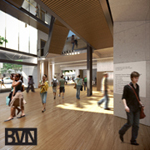
Massing, scale, urban design features and relationships to the surrounding neighbourhood are described in a physical model. Key external and internal features are described in simple perspective sketches. These show the interface of the building and main entrance plaza; incorporation of historic structures; a day-lit, multi-level entrance hall that enables way-finding; a public café overlooking an internal garden; a staff restaurant with favourable long views and inpatient rooms overlooking a well-proportioned, landscaped courtyard; and other key experiential objectives. (Exhibit 5).
Competitive dialogue
All of the above planning and design materials, together with accompanying specifications for civil, structural, mechanical, electrical and communications systems, enabled the achievement of robust cost estimating, outline planning consent, business case approval and permission to launch the invitation to bidders to participate. The process for Bristol leading to selection of preferred bidder is scheduled to take 14 months. Nine months of this is devoted to competitive dialogue in which bidders develop their own proposals, guided by the principles embodied in the materials described above, and by close working with the trust and its advisors.
Whether or not this process will achieve the level of design quality that the trust seeks will only be assured at the end of the bid period – and ultimately only upon completion of the project. We can report, however, that mid-way through bidding, all participants are demonstrating a sound understanding of the trust’s objectives and a commitment of substantial resources to achieving them. To date “Smarter PFI” seems to be working.
Author: Ken Schwarz is a principal of NBBJ Architects
Exhibit 3: PFI shortcomings - A history of remedies
• Guidance to inform the trust team
• Design champion
• CABE enabler
• DoH & CABE design reviews
• AEDET evaluation
• PITN, FITN, BAFO and LAFO
• Competitive dialogue
• 6 – 3 – 1; 4 – 3 – 1; 3 – 2 – 1
• Health expert & generalist architect
• Public Sector Comparator
• Separating design process from BFO bid
• Exemplars, Smart PFI
• Smarter PFI?
|

1.1.jpg)



|