Projects: Student Healthcare Design Awards
|
|
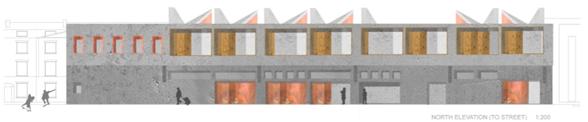
The chimneys in Iseult O'Clery's winning design rise up "like an attic" and
let light into the consultation rooms below, allowing patients to "glimpse the sky"
|
Salutogenic design was firmly in the spotlight at the third international Architects for Health Student Design Awards.
A childhood memory of a fireplace in a doctor’s surgery has translated into a winning design for Ireland’s Iseult O’Clery. Exploring the relationship between light, relationship and health, O’Clery designed a primary health and community centre whose concrete chimneys pick up the grain of the existing adjacent terrace houses and raise the health centre “like an attic” above the community centre, which opens onto a canal side park.
Nestled in each GP’s room is a small waiting room, with light reflected down from a folded copper roof. Examination space in each consultation room is concealed within a timber box, “sitting like a piece of furniture within the room” and lit by a south-facing chimney which allows patients to “glimpse the sky”.
O’Clery’s design topped this year’s Architects for Health (AfH) Student Health Design Awards, presented in London on 27 September. AfH executive board member Jamie Bishop, from Fleet Architects, commented: “Student work is a fertile territory with the licence and luxury to take a critical position on healthcare design, which could and should influence practice in the future. In the design of her consulting and examination room Iseult (O’Clery)’s project ultimately challenged flaws in one of the most common of clinical rooms, flaws which are repeated unchallenged time and time again.”

|
| Judging panel members Paul Serkis (from sponsors Brookfield) and Dr Sam Everington |
Over 80 entries were received for the awards and eight entries shortlisted before the judges retired to an anteroom to debate and elect a winner. The judging panel was chaired by current AfH chair John Cooper.
The other judges included Dr Sam Everington, a GP in London’s Bromley by Bow Centre which was used by the UK government as a model for healthy living centres; Dr Patrick Hutt, a newly qualified GP who has written extensively about general practice and is currently researching the evidence for different health centre configurations; Thomas Gardner, project architect and key Sustainability Group member at Allford Hall Monaghan Morris; Francesca Pont, an architect at Cottrell & Vermeulen Architecture; Paul Serkis, commercial director – infrastructure for Brookfield, sponsor of the awards; and last year’s AfH Student Health Design Award winner Elaine Neish.
The entries were judged against a carefully considered list of criteria, developed since the awards began three years ago, including creativity, aesthetics, whether the applicant had considered patients and staff in the design, and the graphic quality and skill shown in the submission, taking into account at what stage the student was in their career.
Joint runners-up in the competition Jing Zhao, a second-year M Arch student from Texas A&M University, and Agnes Wesolowski, a graduate of the University of Applied Sciences and Arts in Dortmund, Germany, were also applauded for their innovative designs. Zhao designed an outpatient clinic and wellness centre which takes advantage of a creek-side setting in Texas, while Wesolowski’s design created a clinic on the outskirts of Kigoma, Tanzania incorporating an open ‘agora’ space.

|
Judge and AfH chair John Cooper
|
The other six shortlisted designs were: Geoffrey Liddle, a student at Northumbria University, UK who designed a memory centre for dementia care patients; Jonathan Schofield (University of Westminster, UK) for ‘Thames Salmon Rehab’, designed to float on the river Thames; Soren Thiesen from the Royal Danish Academy of Fine Arts – School of Architecture with his response to the high rate of sexual assault in South Africa with his design for a trauma centre for rape victims in Cape Town; Alexander Thomas, a London Metropolitan University student with his proposal for a Venetian hospital; and Ewan Cooper and Ashleigh Donaghey, also from London Metropolitan University, for mental health unit ‘Brooke House’, set in a deprived area of London.
Judging panel member Thomas Gardner commented: “This was a valuable event, showing how healthcare design can raise its head from the interpretation of regulations and take a broader view, looking at how architecture can improve the wellbeing of both the individual and the city.
In future, it would be fascinating to see student push the range of scales further, investigating issues from microbiology to the global health economy, without losing sight of this very real, very personal, human-scale environment in which actual lived experience takes place.”
• Special thanks are given to Brookfield for sponsoring the awards programme and to Jamie Bishop and Fleet Architects for their organisation and support.
|

1.1.jpg)






|