Project report: Amongst the banksia
The design of Western Australia’s Fiona Stanley Hospital reflects not only the needs of the indigenous and migrant populations of the state but also the unique natural environment in which it is set, as Morag Lee explains.
Within the architectural community at large there is still a preconception of the specialist healthcare architect as a planning guru, carefully piecing together a jigsaw of rooms to achieve functionality, efficiency and perhaps very little else – a plodding, logical thinker, deprived by strict clinical requirements and restricted budgets of an environment which will allow them to express true architectural vision. Indeed, many hospitals produced in the late twentieth and early twenty-first century do little to dispel this illusion – but this is changing, and the days of functional, generic hospital models and standardised building templates are well and truly behind us.
The recognition of evidence-based design (EBD) and the now-accepted benefits of a nurturing healthcare environment have to an extent liberated the healthcare designer. While efficiency and affordability will always be prerequisites of the modern public hospital –and few budgets allow for grand architectural ‘flights of fancy’ – today’s hospital architect has the opportunity, nay the obligation, to look beyond the functional. In doing so, they must be fully cognisant of the possible implications of their design choices and display a level of sensitivity above and beyond that required in many other spheres of the architectural profession. In creating a ‘facility for health’, they are obliged not only to display sensitivity to the building’s users, but also to its environment and to the wider society it serves.
Designers are rising to this challenge and a new wave of exciting and distinctive public hospitals are being developed, each responding in a unique way to the very specific location and community they serve.
The development of the new Fiona Stanley Hospital (FSH) in Perth forms the cornerstone of a major healthcare reform programme currently being implemented in Western Australia (WA). Its brief is to facilitate the provision a patient-centric service delivering healthcare in the most user-friendly manner, whether that be through ambulatory or inpatient treatment, hospital in the home or through other regional facilities accessed by telemedicine. In collaboration with its counterpart servicing the northern suburbs of Perth, it is to act as a hub for state-wide tertiary services.
The brief for this project is no different from that of many public hospital developments worldwide – the replacement of facilities no longer able to support modern healthcare practices, the creation of a major tertiary centre serving a network of subsidiary facilities, the development of a virtual hospital network. But while the brief may be
similar, the design for Fiona Stanley Hospital is unique. The facility is distinctly of Western Australia and for Western Australia, responding not only to its physical and climatic context, but also to the cultural and socioeconomic needs of its community.
The design team chosen for this project is a collaboration of three practices: Silver Thomas Hanley, Hassell and Hames Sharley. All three firms are internationally experienced with speciality knowledge in healthcare planning, workplace design and laboratory and education facility development. While fully conversant with global developments in these areas, perhaps just as crucial to the success of this project was that all three practices had a strong local base in Western Australia. As such, they were uniquely placed to fully investigate the context for this project and respond sensitively and respectfully to its needs and objectives. Through lengthy site visits and an extensive programme of consultation with staff, local community and other key stakeholders and reference groups, the project team and its designers developed a detailed facility masterplan. While responding functionally to the clinical briefs – this masterplan went further and addressed a wide range of issues specific to this project – the design response to these issues has had a fundamental effect on the final built solution.
The community culture
Traditionally, outdoor spaces play a vital role in the lives of West Australian people. A fortunate climate and spectacular natural environment have nurtured this philosophy. It was felt that in the design of this new facility, this cultural reference should be addressed and that the provision of usable outdoor areas, natural daylight and access to views should be key design drivers. This decision had a fundamental effect on the development of the architectural model.
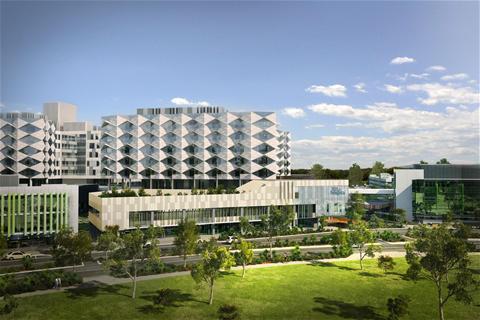
Instead of spreading out to maximise the footplate of the building on the site, the main hospital block rises in height and wraps itself around a large external public park area. This park reaches deep into the heart of the building facilitating light and views, as well as offering external areas for relaxation, exercise and rehabilitation.
The lower podium floors of the building, which through clinical necessity are deeper planned, are penetrated by a network of landscaped courtyards and open-ended corridors. These fragment the building mass, offer external access and views and orientate the user within the footplate. The raised inpatient areas are able to capitalise on rooftop landscaping and views onto the public park and adjacent retained bushland.
“We must acknowledge that WA is undergoing major demographic changes. Ongoing migration, supported by a resource-rich economy has seen the population increase more rapidly than any other Australian state. So in
addition to the requirement to service its current patient base, Fiona Stanley Hospital had to be ultimately flexible to respond to future population needs.”
Geoff Zimmer, director of project delivery, Fiona Stanley Hospital, Department of Health
“The size of Perth’s skilled labour is limited when confronted by specialist construction projects, such as the construction of a large hospital. As a result, the Fiona Stanley Hospital project procured mechanically efficient and off-site manufactured products, reducing labour-intensive systems and work procedures to attract Perth’s best limited skilled labour in this specialist market. Brookfield Multiplex awarded multiple packages of similar disciplines to address the needs of the hospital’s varied building elements, ensuring their timely completion and reducing the project risk. These trade packages were tailored to attract Perth’s supply chain networks.”
Simon Ritchard, Brookfield Multiplex project manager, Fiona Stanley Hospital Project
“For the architectural collaboration it has, and continues to be, an exciting project to work on. We have been fortunate to work with a client, project team and contractor who all share the vision of taking this hospital development beyond
the functional and creating an exciting piece of architecture – one which displays a level of sensitivity and humanity fundamental to this building type.”
George Raffa, project director, FSHDC
Western Australia is made up of a diverse range of peoples, from the traditional aboriginal residents to a wide range of settlers of European, Asian and, more recently, Southern African descent. While each group has its own cultural needs, it is perhaps the local indigenous community who has the most specific requirements and needs the most detailed consideration. Aboriginal people will be a significant patient and visitor group at the hospital; both the buildings and their landscape settings had to be specifically designed to respond to the cultural needs and sensitivities of the indigenous users. A specific reference group was set up to inform this process. This group discussed issues as diverse as departmental locations and layout, seating choices, landscaping options, graphics and colour selection. Some specific issues addressed were:
- provision of a range of outdoor spaces with indigenous planting as a cultural reference point;
- provision of gathering and waiting spaces for large family groups;
- location of key departments close to external areas; and
- location of bereavement facilities to respond to cultural sensitivities and rituals.
The future
In the basic masterplanning of the site it was essential to allow for future growth. This was achieved by predicting the future healthcare scenario based on available data, designing the site to accommodate this, then paring the development back to reflect current requirements. The initial footprint of the hospital was therefore consolidated and zones were set up where future expansion could logically take place without causing major service disruption.
The feasibility of this approach was reliant on the development of a simple and extendable internal circulation system. The basis of this system lay in the complete separation of the main horizontal public and service routes. On the lower ground level, a network of support corridors link the main facility management areas into dedicated vertical risers which feed into the rear of the clinical departments. On the entry level, a public atrium provides physical and visual access to main department entries and public lift cores. Both systems are fully extendable into the proposed expansion zones, while maintaining the purity of the traffic separation and avoiding any service disruption.
In addition to future development, it was recognised that there may be a requirement for internal reconfiguration of the original facility in the future. This was addressed in a number of ways.
- Future-proofing strategies were put in place to facilitate the expected expansion of heavily equipped areas such as theatres and imaging. These included: providing equipment access points and routes for future installations, reinforcing structure to support future equipment loadings, providing serviced shell spaces for immediate conversion, and making available expansion potential by collocation of soft office areas at the boundaries of critical departments.
- Generic rooms were adopted wherever possible and customisation was minimised to allow for easier service relocation.
- Departmental boundaries were deconstructed in favour of collocation of similar room types, thus allowing flexibility between clinical areas and more efficient facility usage.
The site
The site for Fiona Stanley Hospital is unique – and this uniqueness brings with it a requirement for a high level of design responsibility. Located on an area of established native bushland, the hospital has to respond to its location sensitively while still achieving its functional objectives. An example of this was when early investigation of the site identified the presence of a protected bird species. This resulted in the requirement to preserve two large conservation areas on the site, linked through the centre of the proposed development zone by a green corridor populated by local tree species.
This specific requirement had a fundamental effect on the site masterplanning solution. Through discussions with environmental consultants and public and cultural reference groups, it was agreed that the future landscaping of this hospital should not be structured and formal but instead reflect the nature of the site prior to development. To facilitate this, several activities were conducted prior to site clearance:
- salvage of mature trees;
- seed collection and storage; and
- cuttings of species suitable for propagation.
Informal gathering spaces, contemplation points and wander paths have been provided and populated with indigenous plants, creating a rich and unique sense of place.
The uniqueness of the site influenced not only the landscaping philosophy but also the aesthetic of the building itself – the imagery of the bushland and its native flora reflected in the differing strata of the elevational treatment; the strong vertical segmentation of the lower podium levels taking direct reference from the light and shade cast by the bushland tree trunks; the upper ward level paying playful homage to the imagery of the native banskia shrubs which populate the site; and the projections of the window canopies mirroring the open banksia seedpod while cleverly providing
passive shading to the bedrooms behind.
In the main atrium, the ceiling is perforated with random slitted apertures, allowing glimpses of light to filter through, echoing the effect of the tree canopy.
Internally, this reference to the building context continues. The site was analysed through multiple visits; existing colour and textures on the site generated a design palette that is unique to this region. These site references inform the internal fit-out – from material and colour selection to the detailing of areas such as reception desks and seating installations.
The location
While the masterplan identified key areas of consideration to ensure that the design of this development was ‘of its place’, Perth’s unique location had an effect on the design in other ways.
The remoteness of the city of Perth from other large Australian conurbations, has led to its becoming semi-autonomous in nature. In many spheres of industry and design, its relative isolation has caused it to look for inspiration beyond its national cousins in the east, and this was the case with Fiona Stanley Hospital. When the state government looked to develop this particular project, it insisted that its project team was fully conversant with current international research and development trends.
The project teams chosen for both the briefing and design of the hospital were locally based and highly experienced in healthcare development, but the scale of this project allowed these teams to recruit additional personnel with international experience and utilise the services of key specialist consultants. Taking references and drawing evidence from its international sources, the hospital project team was able to fully explore a number of important diverse design issues. Many of the issues reviewed were already known of in WA but the scale and importance of this project provided the first opportunity to fully review their potential.
For example:
- Professor Roger Ulrich’s engagement allowed the full exploration of single-bed requirements for improved health outcomes and patient risk avoidance strategies. This led to a much higher percentage of single bedrooms than had ever previously been provided in WA public hospitals.
- The review of fit-out standards, advocated by the NHS, led to the development of new product types, with local manufacturers becoming actively involved in the development of innovative prototypes.
- A European engineering review led to the acceptance of 100% clean air usage and the take-up of chilled beam technology.
- Construction prefabrication methodologies from the UK public-private partnership (PPP) market were explored for implementation in both engineering and fit-out scenarios.
While not all issues explored were eventually accepted due to budget, locational supply practicalities, industry capacity etc, this project provided a unique forum for a review of issues, the outcomes providing an enhanced knowledge base which could be utilised in future healthcare project planning in the state. This concept of internationally enhanced local experience is prevalent in all constituents of the briefing design and construction and has led to a harmonious union of international issues and local priorities
The construction
In addition to fulfilling its many design criteria, the FSH must also, of course, be a financially viable and constructable building venture. Developing a project of this scale and complexity in a relatively isolated community such as Perth brings with it a whole new range of challenges for both the designer and contractor.
The implications of these constraints were identified early in the project’s design phase. Brookfield Multiplex invaluable construction experience to guide the resolution of the design in conjunction with the design consultants.
It was paramount a strong working relationship was forged early between the hospital’s design team, managing contractor and WA suppliers, which led to customised solutions to resolve product availability constraints.
Conclusion
Fiona Stanley Hospital is now under construction, and is due for completion in December 2013 and occupation in 2014. It is a modern, efficiently planned facility, fully recognising budget, staffing and maintenance issues. Its brief and design have responded to many of the principles of evidence-based design and its project team has been awarded for its proactive approach to the environmental agenda. In addition, the design team, through careful and detailed study of its context and through ongoing engagement with its community, has developed a design solution which is unique, one which could not have been developed anywhere else and is perfectly aligned to the needs of Western Australia.
Morag Lee is a senior health facility planner at Silver Thomas Hanley in Perth, Western Australia
Fiona Stanley Hospital, Perth
Client: Government of Western Australia
Architects: The Fiona Stanley Hospital Collaboration (Silver Thomas Hanley, Hassell, Hames Sharley)
Cost: AUD$2 billion tertiary hospital, including AUD$255.7m for state rehabilitation service
Capacity: 643 acute hospital beds, 140 rehabilitation beds
Area: 150,000sqm gross area, excluding car parks
Schedule: Planning underway since 2004; Construction commenced September 2009; Completion of construction scheduled for December 2013; Opening scheduled for May 2014. |
 |
|

1.1.jpg)



|