Project Report - Elderly Care
Generational Change
The world’s ageing population may present a crisis of care, but a growing understanding of how elderly people want to live and be cared for is translating into some sensitive humanist design, writes Emily Brooks
The world is at a demographic crossroads: in the next five years, the number of adults aged 65 and over will, for the first time, outnumber children under the age of five. Long life represents an incredible achievement for medicine, but it has also created a looming crisis of care that is only just beginning to be felt. In the world’s two most populous countries, China and India, the figures are stark: China’s older population will rise from 110m to 330m by 2050; India’s older population, 60m, will reach 227m by 2050. The problem is exacerbated because, although these countries may be in the midst of economic boom, their current older populations are generally not wealthy enough to pay for their own care. In China, the one-child-per-family rule is set to have a devastating effect on family members caring for elderly relatives: there simply won’t be enough children to take on traditional caring roles, especially given the rise of women who join the workforce rather than take on home-based roles, and the increasing urbanisation that draws children away from where their parents live. Globally, there will be a huge need for care workers who can visit the elderly in their own homes, as well as increased demand for care homes that can attend to the needs of those with dementia, a disease whose prevalence increases with age.
 |
| Garden design for a virtual dementia hospital |
The digital dichotomy
“For many in China, it seems that ‘optimal care’ means support systems for its senior population; for many individuals though, it seems that ‘optimal care’ means support so that individuals can take care of themselves – supported by family members or by outside carers,” says Mel Fairbourn-Varley of DWA Architects, a British practice highly experienced in designing environments for the elderly that is now looking to export its expertise; it has just won a competition to design a ‘care village’ for more than 1,000 residents in Guangzhou, which will be built, wherever possible, in line with the UK’s dementia design guidelines (see case study). “On the one hand, ‘optimal care’ means an independent, assisted or continuous-care community to provide the necessary support systems needed to maintain independence and dignity,” says Fairbourn-Varley. “But, on the other hand, China has also responded by developing often outdated care-home models, the design of which pay little attention to the dignity of individual elderly people.
 
Moorings Park, Naples, Florida, USA
The latest building phase in this upmarket continuing-care retirement community (CCRC), first opened in the 1970s, has seen the introduction of a wellness component, the 3,400sqm Center for Healthy Living. The centre offers a mix of clinical and non-clinical services, including physicians, rehabilitation, an exercise programme geared towards older people, a spa, salon, restaurant and lecture theatre. This approach to keeping body and mind active and well fills some of the perceived gaps in hospital care, and has proved an attractive selling point to those seniors who, until now, have preferred to stay in their own homes rather than move into a retirement community. Perkins Eastman designed the centre, with interiors by Wegman Design Group, while at the same time completing 29 new residential apartments on the 83-acre campus.
Daniel Cinelli, principal at Perkins Eastman, says the senior-living market all over the US is “starting to talk about repositioning their CCRCs in terms of wellness; a lot of the communities we’re working with are really taking it seriously. They’re saying to the hospitals, ‘if you’re not going to be doing it [providing adequate services for seniors], then we’ll go and hire a physician and start a wellness clinic ourselves’.”
Client: Moorings Park
Design architect: Perkins Eastman
Architect of record: Burt Hill/Pollock Krieg Architects
Interior design: Wegman Design Group
Size: 83 acres
Cost: Undisclosed
Completion: 2013
“The elderly-care industry’s current development suffers greatly from the inadequacy of suitably designed senior care and specialist housing facilities. This is coupled with the inadequacies and huge gaps across the country, in both the number and the quality of trained specialist carers and nursing staff, gerontologists, geriatricians and medical specialists.” A collaboration between local government and a local charity, the project hopes to demonstrate to China that, with the right model and expertise, elderly care – and particularly dementia care – can be delivered cost efficiently.
With rising demand for elderly care, China welcomes foreign and private involvement in this sector, but it needs the foresight not to make the same mistakes as the West. Gated, isolated communities of older people are no longer considered economical, or socially beneficial to either residents or wider communities. On the other hand, integration with the wider housing stock keeps people in their own homes for longer, which is cheaper than 24-hour care; and keeps elderly people active within their communities.
“Lots of older people need extra care, but that shouldn’t be a reason to close them off from society. We try to overcome that separation,” says Jan Haerens of Belgian practice 51N4E, which has designed a contemporary extension to a care home in Nevele near Ghent, which opened in 2012. “The idea is that we try to integrate the building and its surroundings – giving the building meaning in the town or village it stands in. We don’t like introspection.” In Nevele’s case, the new extension fills up the remainder of a tight site surrounded by housing, with large windows and broad terraces making the activities within visible to the communities, as well as making the residents feel that they are connected to the wider world. This concept is repeated on a smaller level inside, where residents’ private apartments face on to large corridors, with the option of sliding back the glass living-room wall to integrate the space with the corridor outside. This was 51N4E’s first elderly-care project, and Haerens says that, although one of the biggest challenges was working around all the specific building regulations concerning this sector, in the end it came down to creating something on a human level: “We tried to look at it as a building for collective living rather than a care project – how to live together with a lot of people, whether they are young or old, is the essential question.”
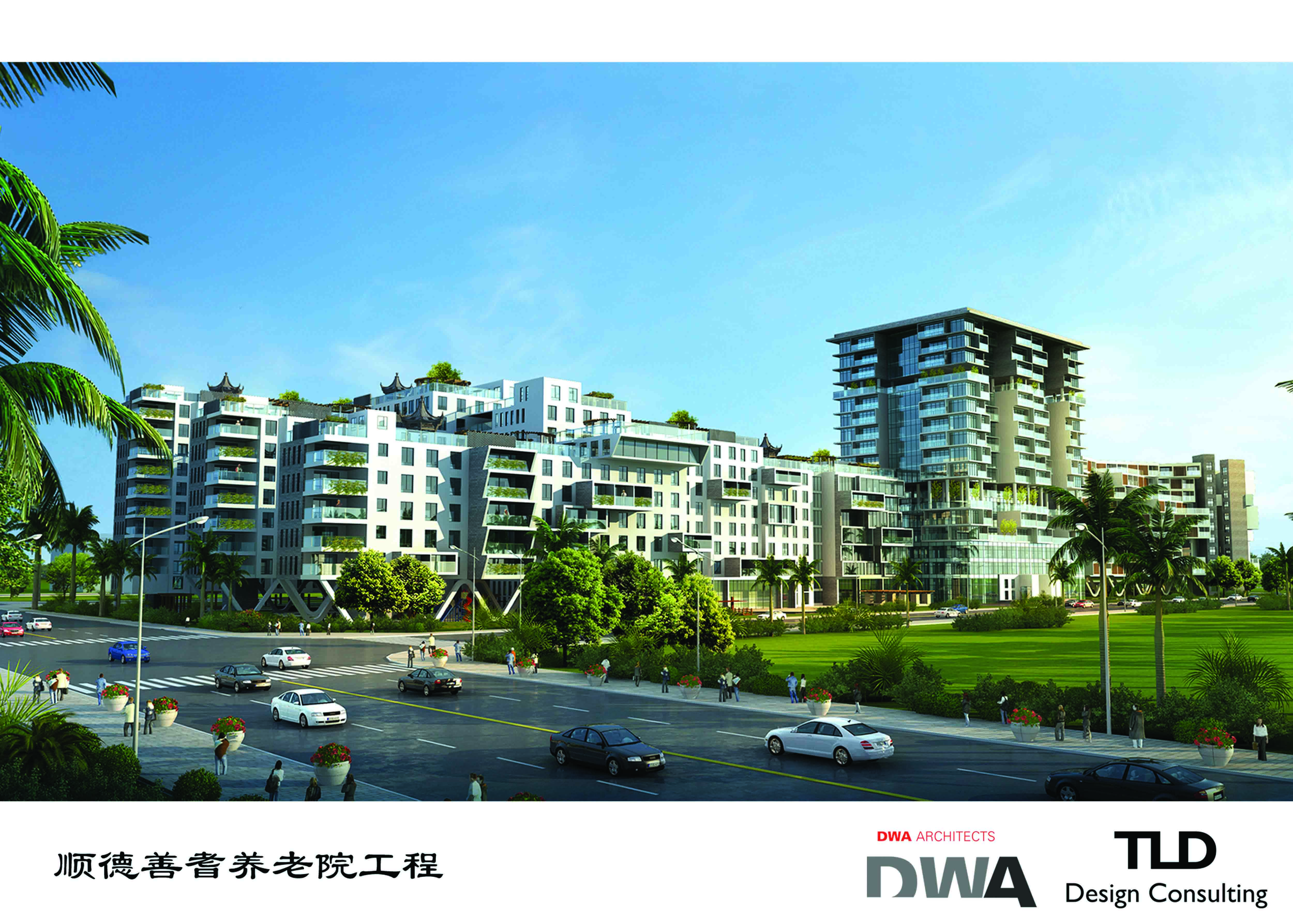 Elderly Person Care Village, Foshan, Guangzhou, Guangdong Province, China Elderly Person Care Village, Foshan, Guangzhou, Guangdong Province, China
British practice DWA Architecture won an international competition to design this elder-care campus, designed to accommodate 750 seniors with severe and terminal care needs and 450 independent and assisted-living specialist apartments. As a collaboration between local government (which has paid for the land) and a local charitable foundation (which will pay for the building of the village), “the express intent is to influence the senior-care market by evidencing that through vibrant public-philanthropic-business partnerships, it is possible to deliver and operate high-quality specialised care that is affordable to the incomes of local populations,” according to DWA Architecture’s Mel Fairbourn-Varley. The community is unusual in its commitment to dementia care, “something many privately invested residential-care operations in China rarely wish to undertake,” he adds.
The architecture is based on UK dementia design standards where possible, with special care taken to provide easy access and movement throughout the campus, inside and out. The buildings are raised above ground level to provide additional space underneath for recreational activities in harsh weather, such as hot and humid conditions. The architecture fuses local Lingnan culture with a more modern, international style, while the landscape will be adorned with native flora, supporting the principle that the environment should be meaningful and familiar to elderly residents, particularly those with dementia.
Architects: DWA Architects/TLD Design Consulting
Size: 67,000sqm
Completion: Estimated 2016
Breaking down walls
In the US, previously cut-off seniors’ developments are using health and wellness as a way to integrate with the wider world. Perkins Eastman’s latest phase for Moorings Park, a Florida continuing-care retirement community (CCRC), includes a Center for Healthy Living with a gym, spa and restaurant, as well as in-house physicians, which is attracting the wider population. “We call it CCRC without walls,” says Perkins Eastman’s principal Daniel Cinelli, who says that many other communities are starting to rethink their proposition in terms of the health facilities they can offer, especially given the way that older generations are now taking more personal responsibility for their health. Cinelli also forsees a further blurring of the borders between clinical and wellness facilities, with diagnostic equipment being added to healthy-living centres.
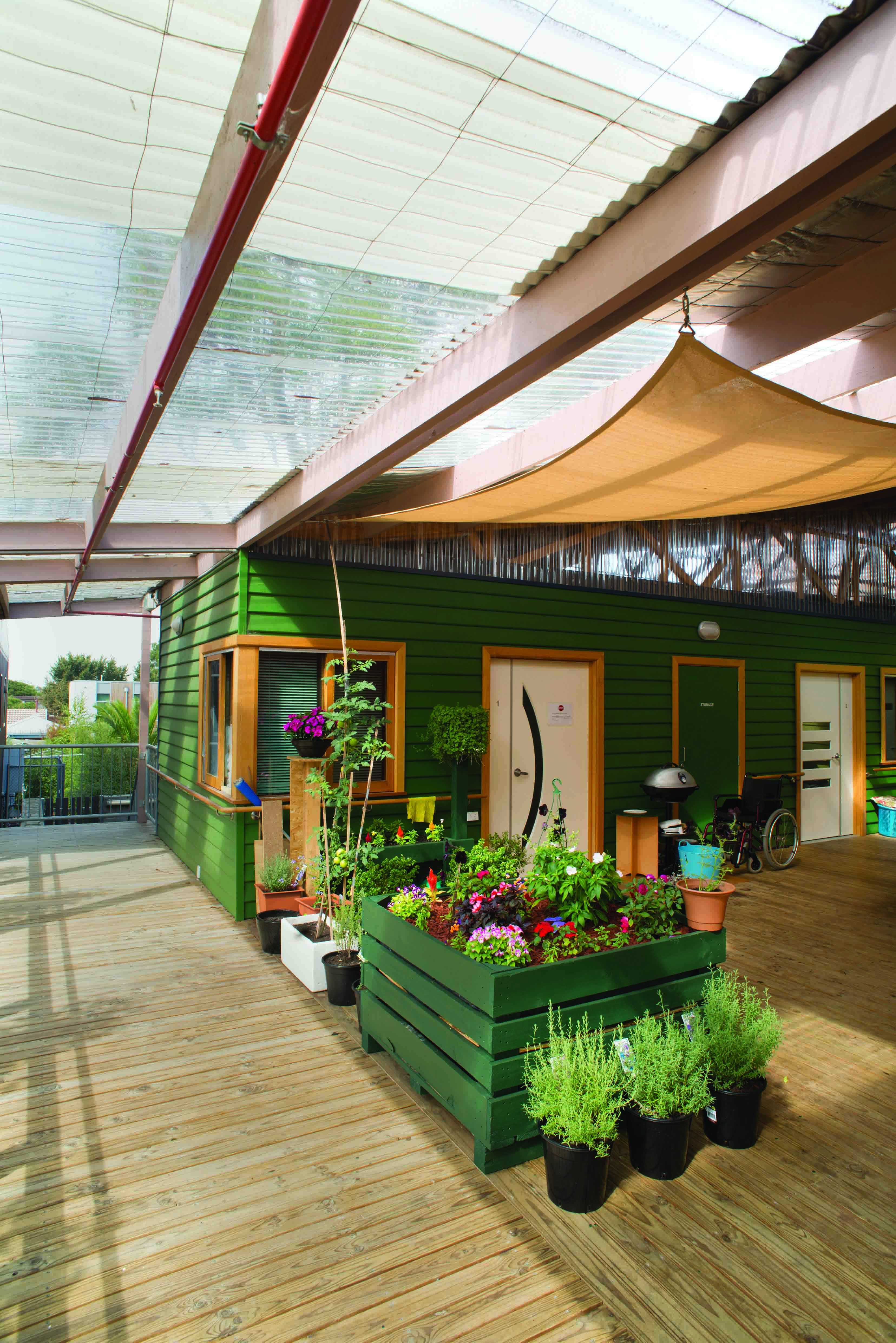 Potter Street Redevelopment, Dandenong, Victoria, Australia Potter Street Redevelopment, Dandenong, Victoria, Australia
Potter Street’s mix of residents – intellectually disabled adults, and the aged – make it an unusual care environment, and allows parents and children to live, and be cared for, together. It is a collaboration between disability-support organisation Wallara and aged-care specialists Wintringham. Allen Kong Architect was charged with providing a supportive environment for those who may have multiple challenging behaviours, eschewing the idea that care settings must be, above all, ‘homelike’ in favour of familiarity and individual control, with direct access to outdoor space central to that concept.
Wayfinding and circulation is provided via a series of verandahs, while living quarters open out on to semi-private courtyards, fostering a sense of privacy and independence while being sociable areas, too. Simple construction materials – timber and polycarbonate – are modular, allowing for future adaptation if residents’ needs change, while a vibrant colour palette provides visual stimulation and helps with wayfinding.
Clients: Wallara Australia & Wintringham
Architect: Allen Kong Architect
Cost AU$12.8m
Completion: 2012
We can also expect to see more dedicated clinical facilities for the elderly. Michigan-based Trinity Health has opened several seniors-only ERs, with plans to open a total of 29 facilities in US hospitals. Here, care is tailored to the over-65s, with a holistic approach that enquires after the whole patient – checking for symptoms of dementia or Parkinson’s and finding out what their care arrangements are at home, not just treating the broken arm they came in with.
In Australia, Allen Kong Architect’s redevelopment of a facility with mixed residents – adults with learning disabilities, and the elderly – puts personal experience and choice at the heart of design. This community is a collaboration between a disability charity and an aged-care specialist provider, and enables disabled children and aged parents to live in the same setting. Access to the outdoors, via residents’ own front doors and along a series of verandahs, offers a sense of ownership and personal choice, as well as delivering all the health benefits of being outside while feeling safe and secure. Kong distinguishes between the usual brief for a care facility – somewhere ‘homelike’ – in favour of somewhere ‘familiar’: “This developed from the understanding that many potential residents did not have a typical home. The idea of familiarity covers a greater range of environments where people will have lived, and the primary aspect of this is access to the outdoors, and emphasis of their own front door to the outside (not to a corridor) – which is a symbol of control over their lives.” This project may be atypical in its mix of residents, but the way it uses space to create somewhere easily readable and navigable could have an application anywhere.
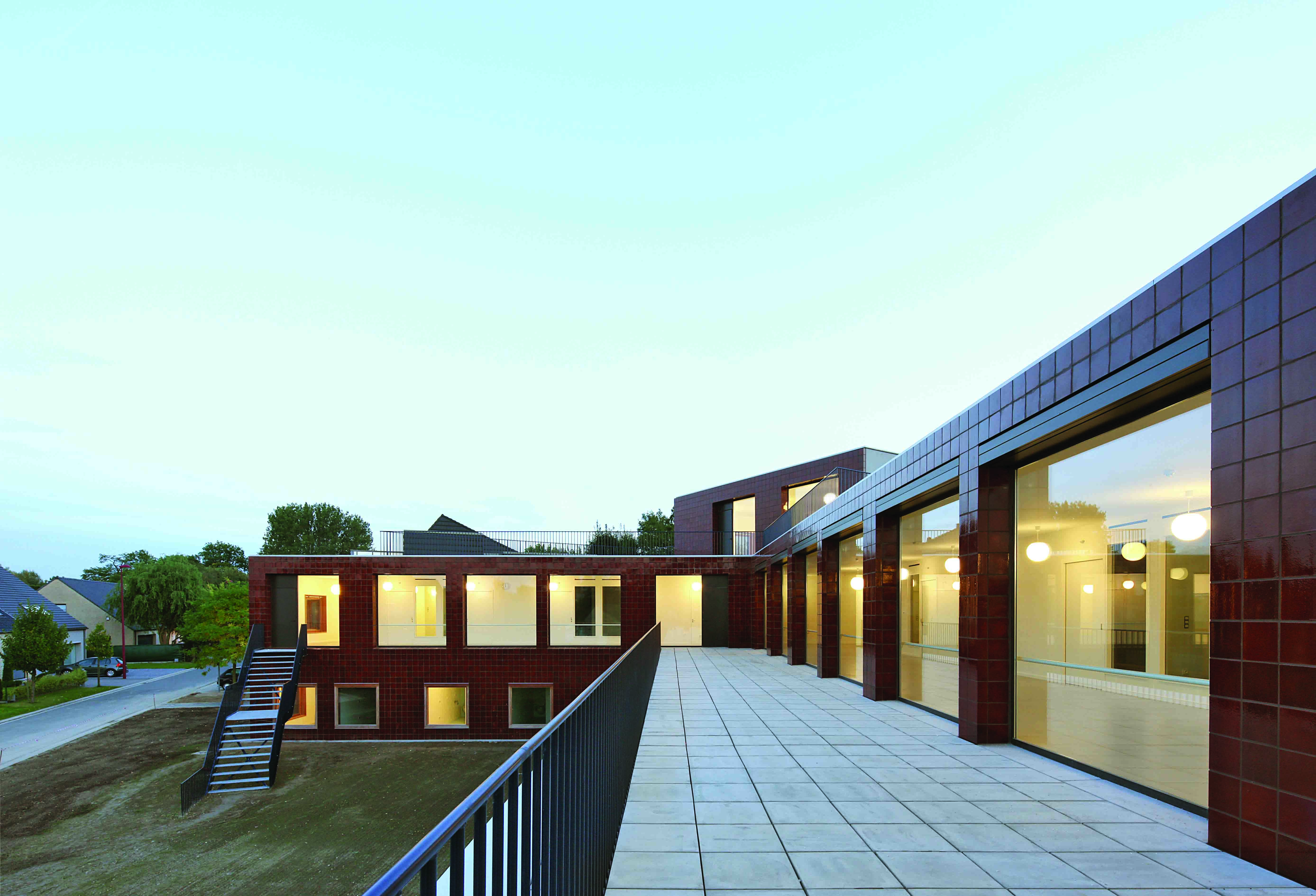 OCMW Nevele Seniors’ Campus, Nevele, Belgium OCMW Nevele Seniors’ Campus, Nevele, Belgium
Brussels-based architects 51N4E won a government-sponsored competition to extend this care home in Nevele, a town just west of Ghent. With no previous experience of designing for the elderly, 51N4E‘s innovative design makes a feature of the corridors outside residents’ rooms – private living spaces directly overlook the wide corridors, so that residents can see the daily comings and goings outside. The glass door between the living quarters and the corridor can be slid back to create a single space; there are separate sleeping quarters further within, which have windows to the outside, and features such as the broad windowsills are intended to make the rooms easily customised with personal effects. Broad external terraces and shared seating spaces for social interaction.
Unlike many care-home models, the architecture is emphatically contemporary, its many large picture windows interspersed with dark red square tiles; those living on the neighbouring housing estate can see the activities inside, as much as the elderly residents can see out, an important part of 51N4E’s philosophy of creating care facilities that are not closed off from their surroundings.
Client: OCMW Nevele
Architect: 51N4E
Size: 4,400sqm
Cost: €6.4m
Completion: 2012
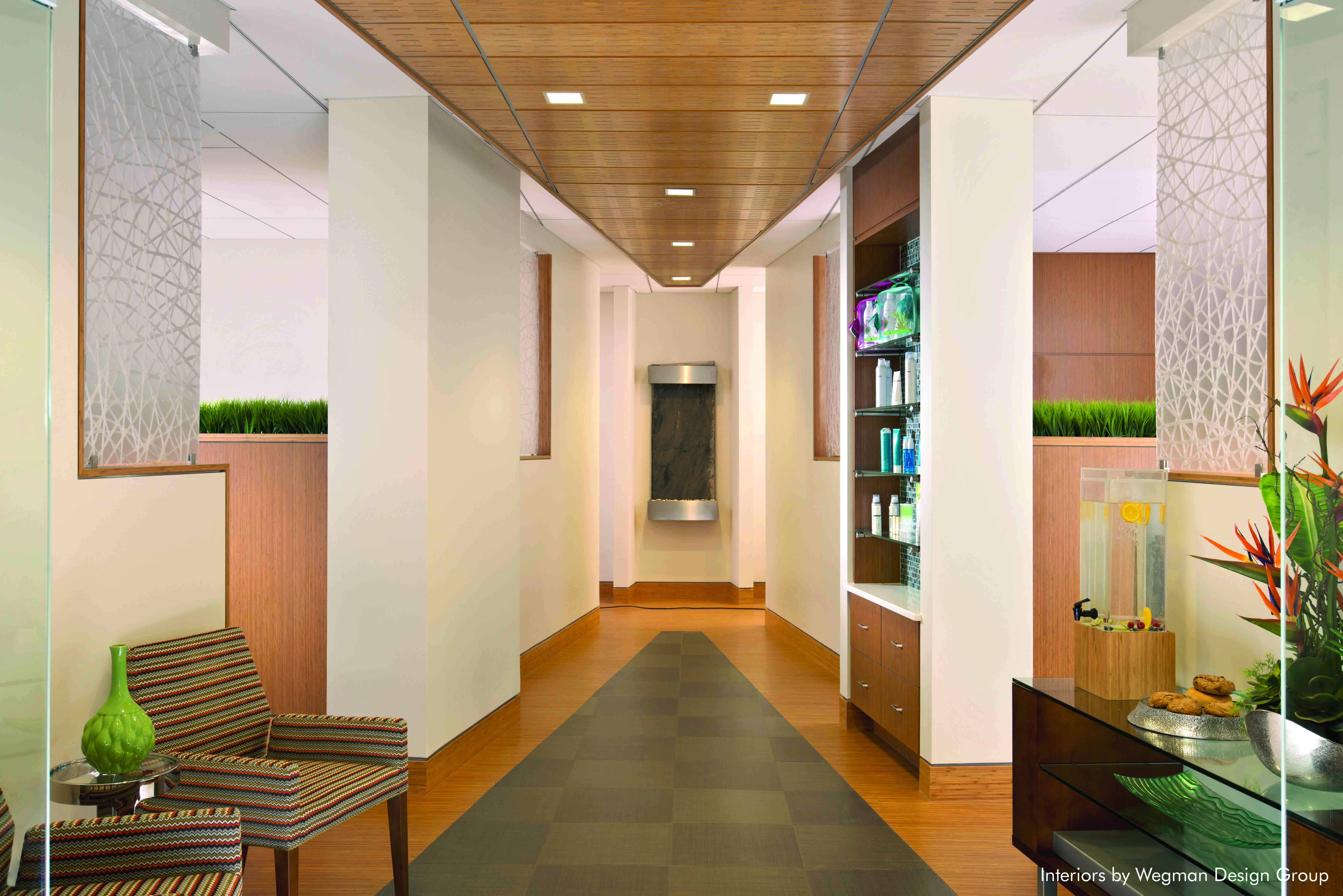 |
| The spa at Moorings Park, Center for Healthy Living |
Dementia-friendly design
The concept of familiarity becomes crucial when designing for those with dementia. In the UK, people with dementia occupy around two-thirds of all residential-care beds, and an appropriately designed environment that is legible and understandable can assist them in being able to look after themselves for longer; this has both health benefits for the individual, and economic benefits, because they need less external care. “It is easy to persuade people that dementia-friendly design makes the cost and burden of caring lighter, and makes life better for the person with dementia,” says Professor June Andrews, director of the Dementia Services Development Centre (DSDC) at the University of Stirling.
Its latest project concerns the design of a ‘virtual hospital’ that is dementia-friendly: half of all patients in acute hospitals have dementia, and Andrews says that “it has been noticed that if a person has to go into an acute hospital – if they break a leg, for example – then it’s relatively unusual for them to return to their previous level of functioning before the hospital admission. We have to ask ourselves: what is it that makes people with dementia have longer stays and be that much more poorly than another person who might be the same age and in the same physical condition, but without dementia?” Acute care’s fast-paced environment, with many faces to recognise, are factors, but design is highly important, too. “If you get the design of the environment right, you only need to do it once and it stays right,” says Andrews. “It makes the job of the staff and the experience of the patient much easier, and it may reduce the length of stay and the number of adverse incidents, such as falls.”
Some of the design measures suggested include a smooth, matt, even-coloured surface for floors, least likely to lead to a fall; good levels of artificial lighting as well as access to daylight (windows should be low enough so patients can see the outdoors while sitting in a chair) or, even better, outside space; and strong signature colours for exit doors and bathroom doors. Dementia-friendly design also requires a degree of understanding about what is most familiar to any given culture or country – elements such as taps and toilet flushes vary greatly across the world, and it is up to the designer to alight on the most recognisable model. However, the majority of suggested features have universal application for those with dementia, giving the DSDC’s research a global reach (the virtual hospital is available to view online at http://dementia.stir.ac.uk/design/virtual-environments/virtual-hospital).
In Australia, Dementia Training Study Centres have been funded by government to disseminate best practice regarding dementia care. The University of Wollongong’s centre has a special remit for design, and last July launched a national education and consultancy service on designing dementia-friendly hospitals and inpatient units, rolling out a series of workshops across every state for architects, health planners and other health professionals. Like the DSDC’s work, it highlights the need to disseminate what are often entirely common-sense principles to a wider audience.
Emily Brooks is an architectural writer
|

1.1.jpg)





|