Process management: Bridging the Gap Between Research and Design
 |
Daylight penetration enhances wellbeing at the new Bexley Wing at St James Institute of Oncology in Leeds, designed by
Anshen + Allen (Pic: Nick Kane)
|
First there was evidence-based medicine – and now evidence-based design applies the same empirical approach to buildings. How are scientific methods being used to guide design decisions?
Evidence-based design (EBD) has taken over the imagination of the design community. Conferences and seminars in the UK and in North America increasingly include papers on what it is, how it’s done and why it’s needed.
Evidence-based design is built on the precedent of evidence-based medicine – that is, relying on up-to-date published research results to make diagnostic and treatment decisions. In part because of its medical roots, EBD has found favour among healthcare designers and architects, especially in North America. In the UK, the concept is being applied more broadly: to housing and new community planning, to crime prevention through environmental design, and to schools and offices1.
Traditionally, the link between research into building design and use and the practical world of design and construction lies in a cluster of pre-design activities known as programming or briefing and post-occupancy evaluation (POE). The time-honoured POE approach identifi es studies of existing building use and performance as a prerequisite to new building design.
Study findings on how users function in the spaces provided, and also on how a building performs in terms of its systems and operation, provide a basis for new building design. Pre-design programming gathers information about users’ needs from available POE studies and other research, and synthesises this information into both broad and generic, and targeted and specific sets of design guidelines and prescriptions to which the design team refers throughout the building design process2.
The goal of this process is to learn from previous projects and to apply this learning to new projects, in a context of continuous improvement. In reality, this neat link between post-occupancy research and design often has more of a hit-or-miss character. The often voluminous results of POE studies commonly lie unread on researchers’ shelves, or are published in academic journals infrequently consulted by practitioners. Moreover, pre-design programming frequently takes the form of a rapid summary of square footage requirements and projected growth in numbers of users, thus allowing each design team to reinvent the wheel, or, more commonly, to reuse ideas they have developed on their previous projects3.
One challenge the EBD approach seems prepared to take up is whether or not an EBD process can replace the typical hit-or-miss application of POE and programming with systematic acquisition of relevant information about building use and users’ requirements that is easily and usefully applied to new design.
Defining evidence-based design
Definitions of EBD include: “The conscientious and judicious use of current best evidence related to the physical environment’s effects on wellbeing, and its critical interpretation, to make significant design decisions based on sound hypotheses (concepts) related to measurable outcomes, for each unique project.”4 And, more simply: “The use of scientific method to guide design decisions based on empirical knowledge.’’5
Attempts have also been made to set priorities on what ‘evidence’ means. It is useful to set priorities on what can be considered evidence:
1. Strong evidence based on independently verified data;
2. Evidence based on weaker data;
3. Evidence from respected authorities based on available data.6
Evidence-based medicine
These definitions, and indeed the whole notion of EBD, are based on a widely respected approach to medical research
known as evidence-based medicine (EBM). EBM lightens the decision-making burden on medical professionals by using research to inform medical decisions. Studies of medical and surgical procedures, their difficulties and their likely outcomes; of treatments such as pharmaceutical products and doses; and of new medical technology and tools, help practitioners to make the best possible diagnosis and select the best treatment.
By referring to the ongoing accumulation of published evidence, a medical professional treats a patient’s condition by using up-to-date objective facts (rather than relying on previously acquired knowledge), as well as their hunches and convictions resulting from experience.
For example, although it may seem obvious that inserting feeding tubes in elderly patients prolongs life, evidence from research has shown that feeding tubes increase infection, and do not in fact prolong life. In theory, the same evidence is available to others involved in treating the patient and even to the patients themselves.
Increasingly, doctors choose to explain to their patients the evidential basis for their decisions – something immediate access to electronic databases makes possible.
Responsibility for an important medical decision is thereby shared between provider and consumer of medical treatments. Moreover, it has been demonstrated that the opportunity for a patient to participate in his or her own care increases the likelihood of a positive medical outcome. Similarly, then, using EBD to support architectural and planning decisions by design professionals provides an opportunity to building users and other consumers of design services to participate in design decision-making.
And studies have indicated that in buildings, as in medicine, informed and engaged users have a more positive experience of the built environment they occupy7.
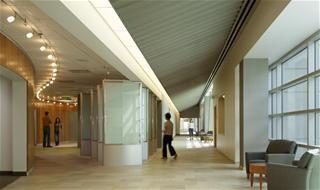 |
Spacious, curved corridors at the Intermountain Medical Centre, Utah, designed by Anshen + Allen (Pic: John Linden and Cesar Rubio
|
The users’ perspective
Basing important decisions on research results rather than on experience, intuition and creativity – whether in medicine or in design – has an effect on the political role of the professional and on the balance of power between providers and consumers of specialised services.
Employing EBD equalises an unequal relationship in the building industry just as it does in modern medicine. Just as the patient has a more important role to play in a medical situation where the doctor shares ‘evidence’ in order to engage the patient in decisions, the architect has an opportunity to enlarge the role of the building’s users and to incorporate their previous experience into key design decisions.
In order to realise its full potential, EBD research incorporates evidence from and about users to make specifi c design decisions. Moreover, the availability of objective information shifts the balance of decision-making power, thereby affecting the outcome of a design and construction project. Professionals who want to continue doing things the same old way will find it difficult to defend this stance with up-to-date research results. Just as doctors take the Hippocratic oath to do no harm, designers and builders who create our environment have a new opportunity to use EBD research not only to protect building users and to do them no harm, but in fact to improve and enhance their environmental experience.
The relationship with POE
This emphasis on the building users’ experience raises the question of whether or not the evidence-based approach to design has supplanted or replaced post-occupancy evaluation (POE) as the way of using data on or about users to inform design. We would argue that EBD and POE remain two related, but distinct, pre-design activities.
First, responsibility for EBD is located in the design process, whereas POEs are considered to be research. Whereas an EBD approach seems by defi nition to support a high-quality design outcome, POE has tended to focus on questioning the design quality of existing projects. The term post-occupancy evaluation has always suffered from the judgemental approach implied by the term ‘evaluation’: the performance of all professionals in a design and construction project risks being ‘evaluated’ by POE. This possibility discourages stakeholders from engaging in POE – not simply an evidence gathering exercise aimed at increasing knowledge about what works and what does not work, but also a judgement on how well the building delivery team performed.
In contrast, EBD contains no mention of evaluation or judgements. It is by definition scientific; it employs approved scientific methods of gathering data. According to labelling theory in social science, something’s name affects how it is viewed and used.
Even if EBD were merely a semantic shift, it may turn out to be an important one, because it changes how designers, owners, and users view and use POE.
As mentioned above, post-occupancy studies tend to limit their data-gathering to the opinions of building occupants – a limited definition of building users – and to whether occupants like or dislike (“are satisfied with”) identified features of a building – a limited definition of how the built environment affects people. Evidence-based research draws on a broader base of stakeholders than simply the occupants of the building at a specific time, and focuses on a range of measurable performance outcomes (such as energy use, health-enhancing qualities and functionality) that supports user activities.
EBD can add to and enhance traditional POE activities, and make pre-design programming a more precise science. A well-documented problem in POE research is the difficulty of finding a simple way to communicate POE results to building professionals in a form that they can use.
Making research results relevant to design is fraught with both logical and practical pitfalls. The language of research – more or less support for a hypothesis, probability of a signifi cant relationship, strengths and weaknesses of the methodology selected – is foreign to the world of building design and construction. Furthermore, all building decisions are made under pressure (time, money, politics, or all three), so it is not possible to make a tentative decision based on the probability of a desired outcome.
A decision is a commitment, and it ends up in three-dimensional form: it is built. Techniques and tools for knowledge transfer – from the theory-based, exploratory and analytic world of research to the practical, deterministic and real-time world of constructing buildings – still need to be developed.
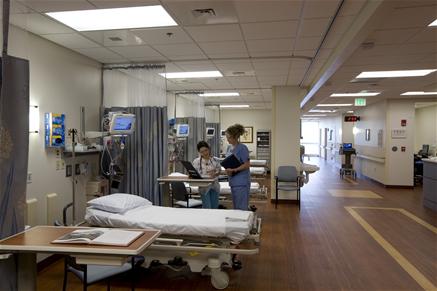 |
Human-centric patient environments: St Mary's Medical Centre in Tennessee, designed by HDR Architects
|
Bridging the gap
A significant advantage of the EBD approach is that building industry professionals can focus and direct research to the issues that they have identified as needing evidence. In other words, each design team is in theory responsible for identifying one or more project-related research topics.
Designers need access to databanks of research results that cover issues likely to arise during project design and construction, much as the medical professional will review published evidence on their current patients’ conditions.
These data repositories are not limited to feedback from building occupants, but ideally should include information about materials selection and performance, construction technology and management, cost containment and risk control, and other areas of knowledge that are key to building successful buildings.
New thinking about EBD is focusing on mechanisms and strategies that enable and facilitate this intimate relationship between research and design, obviating the need for what was a burden on the former POE researcher: to find a way of ‘dressing up’ research results and making them attractive to, and accessible and useable by, design professionals. This was always called ‘bridging the gap’ – ie, the gap that exists between design and research.
The EBD approach requires the design professional to define the research in terms that are relevant to the practitioner’s project. So although they may not design the research – this is the researcher’s area of expertise – they drive the style of applied research projects that seem likely to yield useful new knowledge in a form that makes it relevant to the decisions that are facing them. This shift in EBD decision-making itself ‘bridges the gap’.
Conflict with creativity
As the building design professions shift to a more rational and research-based approach to design, professionals are likely to be less prone to avoid acquiring knowledge that could inform design decisions than they have been in the past.
Architects in particular have tended to express concern that taking a rational approach to design may limit their creativity and ability to have new ideas, that having ‘too much information’ could reduce or even eliminate their ability to find ‘artistic’ solutions to design problems. (In a question-and-answer session at the 2006 Annual General Meeting of the Society for Neuroscience, architect Frank Gehry stated that too much neuroscientific knowledge about people and their responses to buildings would limit his creativity.)
One of the positive impacts of the EBD approach is that it is based on the assumption that more and better information and knowledge will ipso facto improve the design of buildings, and that the value of informed design decision-making not only supports design creativity but – with so much more information available – trying to do without it is both foolish and dangerous. It is no longer considered the action of a responsible professional to embark on a building design project without paying attention to what is known about the impact of previous, related design decisions on human behaviour.
As building-related research expands, building clients, regulatory bodies, and building users will increasingly
expect design professionals to access the growing multidisciplinary knowledge base not only on how building users are affected by features of their environment, but also how to combine what we know about building user psychology and behaviour with the innovative features of buildings that have been certified by green ratings systems such as LEED, Green Star and BREAM.
Recent research
At a recent conference in North America, the range of EBD research reported included a study focusing on systemic problems in how emergency healthcare facilities are designed and operated, in order to identify ways of enabling hospital staff to avoid mistakes and of increasing the effectiveness and efficiency of their time8.
In another example, studies of the impact of improperly performing ventilation systems on illness, discomfort and stress are summarised to indicate ways of improving indoor air quality in a wide variety of building types9. A third study examines a range of methodological approaches in order to demonstrate the close relationship between the way a research hypothesis is formulated and the selection of the appropriate data collection method to test it10.
Examples given include a comparative analysis of various configurations of nursing station designs on nursing outcomes such as time with patients, amount of walking, and accessibility of medications and equipment, measuring the relative proximity of hand-washing facilities to patient care areas and the effect on staff hand-washing behaviour, and assessing the impact of available family sleeping areas and family furniture on families’ perceptions of family-centred care.
Studies like these, which have informed or could inform critical healthcare design decisions, illuminate the enormous potential for implementing a programme of EBD studies that can inform hospital design decisions. A similar richness of studies awaits design researchers in other areas – workspace design, for example. Much of the research in this rapidly growing field of study has responded to critical issues that have arisen in the commercial real estate industry.
These include, but are not limited to, sick building syndrome and indoor air pollution in the 1970s and 1980s, thermal comfort and temperature control as well as ergonomic workspace and management of repetitive strain injuries in the 1990s, broadening out in the current decade to managing noise and distractions in workspace with smaller and more open workstations11.
Our research on how office occupants assess a range of environmental conditions has generated a large amount of evidence on both supportive and non-supportive elements of workspace design. Part of the evidence indicates when and how these affect worker behaviour (task performance, communication with co-workers and employee retention) and worker mood (wellbeing, satisfaction and engagement)12.
Another useful topic for EBD in workspace planning is the optimal balance between individual workspace (offices or workstations, concentration rooms, places to work alone) and shared or communal facilities (meeting rooms, workrooms, coffee rooms and lounges, places that facilitate collaboration). Studies to date indicate that systematic analysis of the tasks people are performing and the environmental requirements for the types of work they are doing provide a solid basis for this key design decision in most instances13.
EBD research and Alzheimer’s
Our environment-behaviour model for Alzheimer’s design is also based on data from multi-site studies in which the correlations between specifi c design characteristics and behavioural health outcomes were measured14. Outcome behaviours or symptoms measured in residents of Alzheimer’s units include social withdrawal, agitation, aggression, depression and psychotic symptoms such as hallucinations15.
Research findings clearly indicate fewer symptoms in more appropriately designed environments: anxiety and aggression are reduced where there is greater privacy and personalisation of bedrooms; social withdrawal is reduced in settings with not more than four communal spaces, each of which has a unique design character that helps residents orient themselves and make choices. There is a lower incidence of depression when exits are camouflaged using less visible electronic locks instead of alarms.
Another key symptom of dementia, which takes up staff time and disrupts the community, is physical agitation. Whereas agitated behaviours do not appear to be affected by environmental design characteristics, verbal and physical agitation taken together are less present in settings that are more residential than institutional.
Verbal agitation is reduced in settings where residents understand more of the sensory input they receive, and where sensory stimuli are controlled; and there were fewer psychotic symptoms in environments with more opportunities for privacy and for personalisation, and where residents could understand their sensory environment. We conclude these outcomes are related to the neuroscience of Alzheimer’s and environmental awareness16.
Neuroscience and architecture is a fast-growing area of research in which links can be identified between the physical features of a building and the mental, emotional and behavioural effects on users, and is likely to have implications for future EBD research17.
Information versus evidence
One of the ways the European approach differs from the North American approach to EBD is the definition of ‘evidence’. In North American design circles, ‘research’ for a design project such as a hospital or office typically ranges from studying examples published in the architectural magazines, to visiting a recently completed project and looking around to see how it looks, perhaps asking a few people working there what they think of it, to systematically interviewing building users and applying the results to an architectural programme or brief, to performing or commissioning a full-scale POE using social science research18.
The EBD approach represents an advance on this loose defi nition of how much knowledge is needed to gather sufficient evidence to build successful projects. At a recent seminar in the UK, specific initiatives – including government incentive programs and investment in innovation to increase urban regeneration and sustainability; a framework for acquiring, assessing and various ways of applying evidence in the workplace and schools; and managing building-related pathology such as offgassing materials that cause asthma – were all described as examples of evidence-based design research.
On both sides of the Atlantic, the EBD approach emphasises that researched evidence must be reliable and acquired using rigour, certainty and validity. The evidence needed for EBD application has a hard edge to it that the casual POE approach does not.
Evidence is not knowledge: design professionals need a reflexive practice to turn information into knowledge19. But evidence from research goes beyond informed opinion – it is predicated on proof.
Therefore hypotheses must be identified and tested in order for designers to claim they are using an EBD approach. Casual user feedback is not a substitute for validating a relationship between users and built space. Progressing from POE to EBD is a natural evolution of those professions concerned with creating the built environment. Basing design decisions on research evidence lends a scientific case to professional design, eventually having a positive effect on clients’ opinions of their designers (and on clients’ willingness to pay for professional design services) in much the same way as other professions such as medicine and law are respected in our culture. As this proof – or evidence – accumulates, it must be stored and maintained for easy access and retrieval in the context of project applications, much as legal decisions and opinions are stored for legal practice and as medical practitioners in clinical practice now have EBM data electronically available.
EBD alters the definition of design from a function of individual creativity to a process of creatively applying rules of evidence to building decision-making. This increase in respectability goes hand-in-hand with greater responsibility – for example, to demonstrate conclusively that the physical environment of hospitals and seniors’ residences is a form of treatment in healthcare, or that the physical environment of the workplace is a tool for performing work.
As designers employing EBD increasingly are able to influence such outcomes, they take on an even greater responsibility: the responsibility not to look the other way when evidence relevant to a design decision is presented, and not to make purely intuitive design decisions when EBD data are available. Designers, design researchers and their clients can now make all their decisions count. We should not miss this opportunity.
Authors

Jacqueline C. Vischer is a professor at the University of Montreal and founder of the New Work Environments Research Group in the Faculty of Environmental Design. Her most recent book is Space Meets Status: Designing Workplace Performance

John Zeisel is president of Hearthstone Alzheimer Care and visiting professor at the University of Salford. He lectures internationally on non-pharmacological approaches to treating Alzheimer’s disease, and his new book I’m Still Here: a Breakthrough Approach to Understanding Someone Living with Alzheimer’s was published in late 2008.
References
1. CABE Evidence-based Design Symposium, London, UK; 23 November 2006.
2. See Blyth, J. and Worthington, J. Managing the Brief for Better Design NY. Spon Press; 2001; and Duerk, D. Architectural Programming: Information Management for Design NY; J.Wiley & Son; 2004.
3. Ouye, J. Programming in a Flat World; paper presented at Environmental Design Research Association conference, Atlanta, GA; 2007.
4. Salvatore, A. Evidence-Based Design Development Update, paper presented at Healthcare Design 90; 2006.
5. Stickler, J. Research Methods for Evidence-based Design, paper presented at Healthcare Design 90; 2006.
6. Patience, S. Materials Scale: the Evidence Base for Materials Performance and Selection CAB. seminar, London, UK; 2006.
7. Preiser W.F.E. and Vischer, J. Assessing Building Performance. Oxford: Elsevier Science Press, 2004.
8. Vaughan, M. The Role of Evidence-Based Design in Creating Patient-Safe Environments in Healthcare Design 90; 2006; op.cit.
9. Hamilton, K. The Evolving Art and Science of Evidence-Based Design in Healthcare Design 90, 2006; op.cit.
10. Stichler, J.F. Research Methods for Evidence-Based Design in Healthcare Design 90; 2006; op.cit.
11. Vischer, J.C. The Concept of Workplace Performance and Its Value to Managers. California Management Review 49(2) Winter 2006.
12. Vischer, J.C. Space Meets Status: Designing Workplace Performance. Oxford: Taylor and Francis/Routledge; 2005.
13. Vischer, J.C. Towards an environmental psychology of workspace: how people are affected by environments for work Architectural Science Review 51(2) June pp.97-108; 2008.
14. Zeisel, J. Inquiry By Design: environment/behavior/neuroscience in architecture, interiors, landscape and planning 2nd Ed. NY; W.W. Norton; 2006.
15. Zeisel et al, Environmental Correlates to Behavioral Outcomes in Alzheimer’s Special Care Units, The Gerontologist, October 2003; Zeisel, J, Hyde, J, and Levkoff, S. Best Practices: An environment-behavior (E-B) model for Alzheimer special care units, American Journal of Alzheimer’s Care & Research, Waltham, MA; 1994. Zeisel, J, and Raia, P. Non-pharmacological Treatment for Alzheimer’s disease: a mind-brain approach American Journal of Alzheimer’s Disease and Other Dementias 15(6), 2000.
16. Zeisel, J. I’m Still Here: a breakthrough approach to understanding someone living with Alzheimer’s New York: Avery (Penguin) Books; 2008 in press.
17. Eberhard, J. Architecture and the Brain: a New Knowledge Base from Neuroscience. NY: Greenway Communications; 2007.
18. Preiser, W.F.E. Post-Occupancy Evaluation NY: Van Nostrand Reinhold; 1998.
19. Schon, D. The Refl ective Practitioner: How Professionals Think In Action NY. Basic Books; 1983.
|

1.1.jpg)





|