Children's Hospitals: Positive Performance
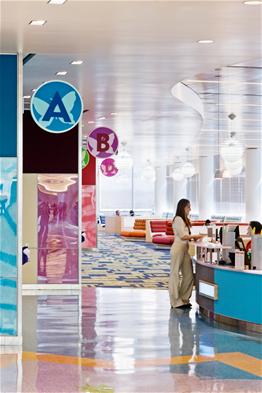 |
| Patients were consulted during the design process, which ensures clear wayfinding in outpatient areas to reduce stress |
With a design driven by consultation, The Children’s Hospital in Denver has successfully delivered both health and financial benefits, writes Sharron van der Meulen and Terri Johnson.
Since its founding in 1908, The Children’s Hospital (TCH) in Denver, Colorado, has grown from a mere 200 inpatient visits to more than 10,000 visits a year. During the last century, TCH has established a national reputation as a top-five pediatric hospital (as ranked by US News and World Report), and with the 2007 opening of its new home, it is looking to further enhance its reputation by providing ever-better care in an environment designed to enhance healing as much as possible.
Housing 270 patient beds, outpatient clinics, a pavilion for specialised services, and offices and research spaces, the 134,000-square-metre (1.44m square foot) hospital is organised around a central atrium that draws light deep into the structure. The spirit of the hospital is captured in a terrazzo floor that runs across the entire space and incorporates butterflies, snowflakes, fish and other motifs. The floor is part of a larger art programme intended to reinforce connections to nature and the Colorado region, foster a sense of optimism, and provide distraction for patients and staff alike.
Drawing on colour theory and research demonstrating the benefi ts of colour on healing1,2,3, careful consideration was given to the amount, intensity and value of colours used throughout the hospital. As a result, five distinct colour palettes were developed and applied to areas where their impact is most beneficial – brighter palettes are used in areas like the atrium, cafeteria and clinic areas, while a more subdued palette was applied in the chapel, intensive care and respite areas.
Harvesting natural light
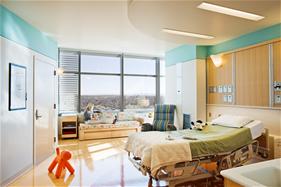
Utilising natural light was another design priority. With studies showing the benefits of bright light in reducing depression and agitation, improving sleep and circadian rhythms, reducing pain, and even shortening the length of stay in a hospital4, ample natural light is provided via windows and light wells. The front of the outpatient wing consists of floor-to-ceiling glass, and interior roof terraces are used throughout to further harvest natural light and enhance interior spaces.
 |
|
The abundant use of natural light was a design priority
|
Additional design decisions were driven by information gathered from focus groups held with patients, families and staff, and from observations collected by a team of designers who spent two weeks shadowing and interviewing families, patients and more than 250 hospital staff. This process led to redesigned nursing stations, an improved patient room layout, changes to the surgical and emergency departments, and features designed to improve lighting, reduce noise and prevent infections.
The design team was asked by nursing leadership to consider decentralised charting stations to maximise bedside care while retaining a caregivers’ ‘hub’ for collaborative team consultations, private conversations, visitors and administrative functions. The resulting caregiver stations are a unique hybrid design, coupling a centralised station that maintains a strong sense of community and provides privacy for caregivers with decentralised workstations that improve caregiver-to-patient contact.
Research into patient rooms made it clear that crowding, lack of storage and inadequate sleeping accommodation for parents were disadvantageous. As a result, single-patient rooms are organised into patient, family and caregiver ‘zones’ to provide adequate space and minimise encroachment of space for clinical care – a solution in alignment with observations by medical professionals elsewhere5.
Additional amenities include a gelato bar, landscaped gardens, play areas, outdoor terraces, and for teenage patients, an area with a cinema, pool table and music/reading room. Staff can enjoy their own exercise facilities, lounges, showers and a terrace.
 |
|
The hospital has delivered both health and financial benefits
|
Improved performance
The hospital’s ability to translate patient, staff and family feedback into the new design has been critical. Relative to patient and family satisfaction, TCH is now a national leader, with performance evaluations showing improvement in every measured category, from the appearance (76 to 96) and overall comfort of patient rooms (83 to 91), to the comfort of overnight facilities (>60 to 74) and visitor accommodations (70 to 86), to the cheerfulness of the hospital (87 to 94).
The new hospital has delivered financial benefi ts for TCH and its patients as well, with the cost of treatment dropping $24 per adjusted patient day due to increased efficiencies. Voluntary turnover for hospital staff and nurses has declined from almost 10% to 7.3% and 4.4% respectively, and turnover for first-year employees has declined from 13% to 8%.
The critical role that the hospital’s design has played in these and other positive results is undeniable.
Authors

Sharron van der Meulen, principal, Zimmer Gunsul Frasca Architects

Terri Johnson are both principals of Zimmer Gunsul Frasca Architects
References
1. Andrews, T. How to Heal with Color; 2001.
2. Gimble, T. Healing with Color and Light; 1994.
3. Roeder, C. Using Color & Light as Medicine. Journal of Healthcare Design; 1996.
4. Ulrich, R.S. How Design Impacts Wellness. Healthcare Forum Journal; September 1992, 20-25.
5. Jones, W. MOH, President of the New Century Healthcare Institute, Healthcare Design; March 2003, 71.
The Children's Hospital (TCH), Denver, US
Project completion date: October 2007
Contract form: Design, Bid, Build with CM/GC
Project Cost: $560m
Construction Cost: $425m
Client: The Children’s Hospital
Design Architect: Zimmer Gunsul Frasca Architects
Architect of Record: H+L Architecture
Structural engineer: S.A. Miro,
M/E/P Engineer: Bard, Rao + Athanas Consulting Engineers
Main contractor: Phipps/McCarthy Joint Venture
|

1.1.jpg)






|