Perception and Wellbeing: The Impact of Colour and Light
Two New Zealand studies explore how the built environment can impact on mood – one, the internal features of a dentist’s office, the other views from an office building.
People who are not normally bothered by anxiety may feel stress and anxiety in specific environments, where they experience both a sensory insult and a loss of power to change or control the conditions.
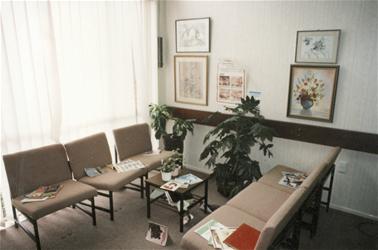 |
| Dentist's waiting room: while plants made people feel more welcome, a general state of untidiness had a contrary impact |
Some environmental stressors, such as noise, extremes of temperature or malodour, are well documented1,2,3. But negative emotional responses can also be learned – in hospitals or dentists’ rooms, for example.
Environmental psychology can also be applied to the workplace. Studies have established relationships between the physical environment and both work attitudes4,5, and wellbeing6,7. Elements such as window size, sunlight or view, have been shown to affect levels of arousal and stress recovery8,9 and even intention to quit6.
The benefits of ‘natural’ elements are well documented10,11. Stigsdotter12 explored stress and access to garden environments in Sweden, reporting greater workplace comfort where garden access was available, and asking whether a garden view could also have a causal influence on workplace wellbeing.
This paper reports on two New Zealand studies, each contributing to the growing body of knowledge on environmental perception and well-being, then discusses colour and/or light as explanatory mechanisms.
Study 1: ‘Greens’
The study of a dentist’s waiting room has been cited as a ‘methods’ paper, using environmental perception to illustrate how the choice of methodology can elicit different levels of understanding of a phenomena13. It was a partial replication of a study where Campbell14 showed students a one-off 35mm-slide presentation of a professor’s office and asked the students to rate their feelings about the environment and the professor. Campbell found that the presence of plants had a strong positive influence on students’ feelings and the assumptions they made about the professor’s character.
In Jones’ study, a dentist’s waiting room was presented using overhead projector slides – also to university students, but in groups. This made it possible to add a qualitative stage, where the groups discussed the experiment. The 102 students rated the 16 environments covering all combinations of the four independent variables – art, plants, seating arrangement and level of tidiness. The dependent variables rated how welcome and inviting it felt, and attributions about the dentist.
Ratings for the dentist’s waiting room showed a near parallel pattern to the professor’s office across all variables, except the dentist’s waiting room was always more negatively rated than the professor’s office.
Table 1 shows the relative ratings, by mean score only, of each of the environments. Tidy waiting rooms with plants had the four highest scores. The presence of plants provided more positive ratings for feeling welcome and feeling comfortable. Only in some combinations did art made a positive difference. Seating variations were not significant.
While tidiness had very high scores, this was not significant either. The significance level was set at p< 0.05 (two-tailed) with 14 df in all cases. In discussion, it was thought that the preferred seating would be one conducive to conversation between waiting patients.
However, while most participants agreed that this would be the preferred arrangement in non-threatening environments, it was not the same for the dentist’s waiting room – some preferred withdrawing from social contact when stressed and did not like seating where they felt they must interact.
Others, however, said they would welcome social contact as both a distraction and support when stressed. There were also competing discourses about tidiness. The cultural value placed on tidiness was explored and its implications for the quality of dentistry: if a dentist could not keep the waiting room tidy, could patients expect quality dental work? An untidy waiting room in a solo practice might suggest the dentist was busy and so was perceived positively. But in a large practice, the students felt untidiness indicated lower standards and less concern for patients’ welfare.
Plants were spontaneously and specifically discussed, but more to suggest that ‘greenery’ is an important element in a wider variety of environments than the dentist’s waiting room. However, gender differences may confound this finding.
In a review of gender effects in environmental research, Zelezny, Chua and Aldrich15 found that women held stronger attitudes to environmental issues than men. In the Jones study13, the ratio of women to men was seven to three.
Study 2: ‘Blues’
The relationship between the environment and physiological aspects of wellbeing is important for understanding the health implications of different types of employment16,17. Physical health may be adversely affected by stress18, including ‘daily hassles’19 and more severe trauma20. Studies have linked wellbeing with windows7,, lighting and natural illumination21, and natural views11,22,23.
Mood (affect) has been suggested as the mediating factor linking environment and wellbeing, with pleasant environments either evoking a positive affect or lowering the negative affect and buffering the impact of stress.
Restorative environments have been shown to lower blood-pressure10,24 and cardiac inter-beat interval25. The aim of this study was to examine the influence of view on employee mood and self-rated health at a single workplace, based on the work of Ulrich8,9,23 and Hartig et al.10.
The hypothesis was based on the probable link between office view and wellbeing, with mood as a likely mediating factor. A good view was predicted to be associated with higher positive affect and/or lower negative affect scores – and with better perceived health. Confounds from age, organisational seniority and sex were anticipated.
Method
Eighty anonymous participants were recruited through a questionnaire delivered to staff mailboxes at the National Institute of Water and Atmospheric Research (NIWA), in Wellington, New Zealand. There were no inducements. The NIWA building is oriented roughly north-south. Offi ces either faced east, with a natural view, or west, facing an urban development. The 200+ employees were mainly scientists, and formed a relatively homogeneous population in work tasks, socio-economic status and intelligence.
The questionnaire instructed participants to consider their responses “while at work”. It included the Positive and Negative Affect Schedule (PANAS)26 for mood states, and three visual analogue scales (VAS). The first rated job satisfaction, the second was for perceived health, and the third assessed how the participant rated the health of an average person of a similar age. Demographic questions covered the employment variables at the NIWA.
Finally, participants were asked to rate their east- or west-facing office view on a four-point scale (poor to excellent), and to indicate time spent in their office on an average working day. In addition, they were asked for the date and time they completed the survey, in order to control for possible confounding or moderating effects such as weather or day of the week.
Table 1: Overall mean DV ratings (9=high; l=low) (Highest rated environments are shaded)
|
| IV art |
IV plants |
IV seating |
IV tidiness |
Mean of combined welcome/comfort rating |
Mean rating of how busy dentist was |
| Art |
Plants |
Open |
Tidy |
3.73 |
6.06 |
| Art |
Plants |
Open |
Messy |
4.88 |
4.35 |
| Art |
Plants |
Closed |
Tidy |
3.82 |
5.99 |
| Art |
Plants |
Closed |
Messy |
5.50 |
4.27 |
| Art |
No plants |
Open |
Tidy |
4.26 |
5.81 |
| Art |
No plants |
Open |
Messy |
4.78 |
4.09 |
| Art |
No plants |
Closed |
Tidy |
4.10 |
5.85 |
| Art |
No plants |
Closed |
Messy |
4.41 |
3.81 |
| No art |
Plants |
Open |
Tidy |
4.28 |
5.92 |
| No art |
Plants |
Open |
Messy |
5.97 |
4.31 |
| No art |
Plants |
Closed |
Tidy |
3.34 |
6.33 |
| No art |
Plants |
Closed |
Messy |
5.37 |
4.08 |
| No art |
No plants |
Open |
Tidy |
2.30 |
6.14 |
| No art |
No plants |
Open |
Messy |
4.07 |
3.88 |
| No art |
No plants |
Closed |
Tidy |
3.38 |
6.30 |
| No art |
No plants |
Closed |
Messy |
3.81 |
4.21 |
Results
The data was grouped separately for the occupants of offi ces with a natural view (east) and those with the urban view (west). Self-rated health results were adjusted so that reported scores refl ected the extent to which the participants believed their health was better or worse than expected for their age. Data were analysed using SPSS.
There was no difference in positive affect scores no matter what the view but there was a small difference in negative affect, showing that people with the urban view were ‘grumpier’ on average than those with a natural view.
For self-rated health, the natural view was significantly correlated with better health than the urban view (t = 2.47, df (78), p = 0.02), even though those with the urban view rated their health as above average for their age. There was a significant, low to moderate positive correlation between self-rated health and negative affect (R = 0.3308, p <0.01).
Job satisfaction showed a minimal and non-significant correlation with health and no correlation to either category of view. To explore further infl uences on perceived health, analysis of covariance (ANCOVA) calculations were used to determine whether the relationship between view and health was mediated by negative affect or some other factor.
After testing for between-subjects effects of positive affect, negative affect and job satisfaction, the view-health relationship was found to maintain significance (p = 0.038). This indicated an independently signifi cant correlation between view type and perceived health, with negative affect acting as a moderator in the relationship.
Discussion
The results supported the hypothesis that there would be a small difference in perceived health between participants with a natural view from their offi ce windows and those with an urban view. A notable departure from previous studies, such as that by Ulrich23, was that despite a correlation between negative affect and view type, the relationship between view and health persisted even when mood was controlled for. Positive affect was not shown to vary with either view type or health status.
Furthermore, the study conditions were a conservative test of the effect of view, given that the urban view was not especially unpleasant and that the employees had access to sea views at other times.
It is possible that the observed relationship might not be due to the sea view at all, but an effect linked to the subliminal effects of colour or colour combinations, such as blue on blue (sea and sky), or blue and green (sea/sky and peninsula), or the amount of sea or sky or green peninsula that was visible.
Neither can it be excluded that, with marine scientist respondents, a sea view maximised the ‘congruence’ between environmental perception and activities or aspirations.
A similar hypothesis by Stone27 has been tested and supported. It is interesting to speculate on what the fi ndings would have been had the respondents been architects or psychologists. If people intrinsically prefer a sea view, then assertive workers may work to gain this advantage28,29,30.
This led us to wonder about a number of possible confounding and/or moderating variables. For example, how does the geographical or cultural context of a view impact on wellbeing? Would people from landlocked nations and maritime nations have the same correlation between mood and sea view?
While the NIWA offices had similar hours of sunlight, new research in circadian rhythms suggests the time of day maximum sunlight is experienced is important. Synchronicity between personal circadian and external diurnal rhythms promoted by exposure to early morning sunlight may be the reason those with east-facing offices had better perceived health. This could be explored in a future study by measuring perceived fatigue versus office orientation or brightness and timing natural illumination.
When Mayo and colleagues31 discovered that manipulating factory lighting led to improvements in production, their groundbreaking message was that doing anything for employees may improve productivity because people respond to attention. However, 70 years on, what might have been lost with the establishment of the ‘Hawthorne effect’32 is that lighting does have psychophysical effects. Workers may have been responding to attention AND light after all.
Conclusion
Study 1 concluded that greenery made such a positive impact that not only might dental patients feel more comfortable in a plant-containing waiting room, but we suggest that the dentist-patient interaction might be improved by this simple modification. Importantly, exploring the environmental context of anxiety shifted from individual coping to acknowledging the wider influences on behavioural reactions and hence the importance of design on wellbeing.
Study 2 concluded that there was a positive relationship between natural views and office occupants’ wellbeing. Colours in the view, especially blues and greens, and light are suggested as the critical variables.
Together the findings raise questions about possible unconscious needs for certain colours, particularly blue and green. Lewis33, Kozak34, and Norfolk35 go further to suggest that evolution ties us inextricably to nature and fundamental narratives in Western culture may reinforce the connections, making access to nature a prerequisite to wellness. The urban descriptor ‘concrete jungle’ is associated with misery. It encompasses both what there is (concrete) and what is missing (jungle). We trust that collaboration between social science and innovative design may lead to solutions.
Authors

Dr Linda Jones, School of Psychology, Massey University, Wellington
Dr Manighetti, Department of Psychology, Victoria University, Wellington
Acknowledgments
BM thanks the management and staff of the National Institute of Water and Atmospheric Research for facilitating the study and Steve Humphries and Antony Gomez for advice. LJ thanks Dr P Moodie for the use of Karori Medical Centre for the photography used in study 1, and photographers Markham Mail LRPS and Colin Jones Participants with the urban view were ‘grumpier’ on average than those with the sea view.
|

1.1.jpg)






|