Nightingale wins £840m Scottish ‘super hospital’
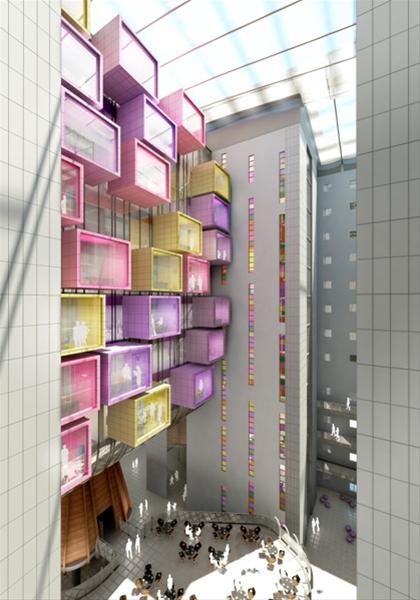 |
Atrium raised at Glasgow Southern General
|
One of the largest hospital contracts ever commissioned in the UK has been awarded to Nightingale Associates, as part of the Brookfield Constructions UK Consortium, which beat off competition from Laing O’Rourke and Balfour Beatty.
The £840m hospital redevelopment in Glasgow city centre of the South Glasgow Hospital Campus, which is the largest contract won in Nightingale’s twenty year history, will span 170,000msq (28 hectares) and will be one of the largest “health campuses” in Europe.
It will centralise acute services currently provided by three different hospitals and will comprise of a 1,100-bed adult hospital; 240-bed children’s hospital; laboratory facilities and support accommodation. Within these facilities, the development will contain many new features including a new cancer hospital; cardiothoracic service and cardiology unit; two maternity units; two new ambulatory care hospitals, state-of-the-art screening laboratory and an A&E department.
Neil Murphy, principal of the London studio, said: “This is a significant opportunity for Nightingale Associates. Not only for the size of the contract, but also because it marks another very significant step forward for us into the Scottish healthcare market. We are extremely excited at this news and very much looking forward to working with Brookfield Construction and the Board over the coming years.”
Funded by public capital, the new South Glasgow Hospital will form part of a period of change for NHS Greater Glasgow and Clyde (the Board). Over the past ten years, it has been developing its Acute Services Review, which will modernise acute adult and children’s health services in Glasgow. The contract will be completed in four phases, and will be a transformation of the Board’s existing facilities.
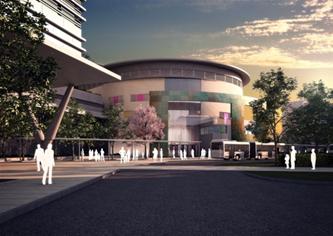 |
Children's entrance at the front of South Glasgow hospital
|
Murphy added: “One of the main design features is the integration of the adult and the children’s hospitals. While each are separate buildings with their own unique identities, there are many interlinking features that will create a strong relationship between the two. Internally and externally, the use of colour will play a major role in this.
“Colour and texture will be used to define different areas and functions within the complex and to create appropriate identities. Natural light will be maximised where possible and attention will be given to providing pleasing views both inside the building and out. The use of colour and other design solutions will also be used for way-finding purposes, allowing users to self-navigate with ease throughout the buildings’ many functions."
The project, which will start on site in November 2010, is scheduled to reach completion of all stages in 2015.
|

1.1.jpg)



|