Innovation Frontier
 |
How do innovative technologies, such as Maquet's PowerLED light relate to the physical environment?
|
James Barlow describes the planning, delivery and operational challenges of creating effective healthcare infrastructure systems in a period of rapid social and technological change.
The healthcare system is one of the most complex and rapidly changing organisational and technical environments in advanced economies. In most countries many stakeholders from the public, private and voluntary sectors are involved.
The mechanisms for funding, payment and reimbursement for services are often convoluted. The policy context may be dynamic, with governments regularly introducing new targets and objectives. And all this is taking place against a backdrop of evolving patterns of demand associated with shifts in demography and morbidity.
Modernising the health and social care system to address the emerging demands is a priority for many governments. In the UK, wide-ranging organisational and funding reforms are being put in place and an unprecedented investment to renew the built and technical infrastructure for healthcare is underway. Many new hospitals and primary care facilities are being built, and a national programme to introduce new information and communication technology to support health services is being implemented.
Planning, delivering and operating infrastructure that will meet future healthcare needs poses significant challenges, not least because the lifecycles of the various elements of the health system – the built and technological environment, service delivery practices and policies – are mismatched.
The infrastructure challenge
These mismatched lifecycles of the healthcare infrastructure system’s elements, coupled with the multiple stakeholder needs and differing institutional and funding arrangements which have to be reconciled, lie at the heart of the ‘infrastructure challenge’. In the UK, this is compounded by a historic legacy of outdated buildings and cultures within the healthcare system.
Because of their durability and impact across society, how to cope with future uncertainties has long been seen as a key problem for planning, designing and managing complex engineered systems. Over the lengthy delivery and operational contracts, typical of much complex infrastructure, there is likely to be a high degree of future uncertainty and risk. This arises from changing patterns of demand, which may not match the levels projected at the time of initial project planning. And while demographic or morbidity trends can be relatively predictable, unanticipated legislative or policy changes may substantially reduce demand or increase costs. Technological advances over a lengthy procurement, delivery and operational period may also mean that infrastructure designed in 2008 is obsolete by 2028.
Healthcare infrastructure is a prime example of a complex engineered system facing such uncertainties. It consists of many functional and operationally interconnected built and technical elements which interact with non-built systems such as organisational and financial structures.
Both the healthcare infrastructure and service systems are subject to continuously evolving demand. Furthermore, the relationships between innovation in the technologies, infrastructure and services associated with healthcare are themselves complex. Cycle times for changes in these elements vary considerably between long-lasting fixed capital infrastructures, more rapidly changing technologies and services, and a frequently unstable policy context. In the UK, the current programme for building and operating new hospitals involves privately financed contracts for 30 years or more, but incorporates technologies which may have five-year life cycles. These are helping to deliver diagnostics and therapies, which are undergoing rapid evolutionary change.
Even though a project to design and build a new hospital may not be inherently complex, it will almost certainly be taking place within an environment where there is considerable market and technological uncertainty. High switching costs – in terms of time, money and disruption associated with adapting infrastructure to changes in services and demand – make it especially important to carefully plan healthcare built assets either for future adaptation or closure. In the UK, for example, a fragmented system for planning and delivering healthcare infrastructure is becoming increasingly exposed at a time when the context for care services is undergoing rapid change.
Modern healthcare systems around the world are faced with similar dilemmas. Two core areas that need to be addressed are: integrating services and infrastructure planning and delivery, and how to stimulate and sustain innovation in infrastructure provision.
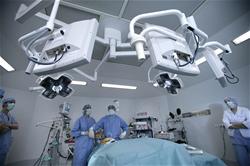 |
| Effective infrastructure planning requires integration of new technologies, such as Maquet's Satellite ceiling suspension system |
Integrating services and infrastructure planning
As previously noted, increasing the flexibility of healthcare infrastructure to meet rapidly changing services and practices usually involves high switching costs. A more sophisticated and holistic approach to planning infrastructure and services is needed. However, this poses some interesting questions which require investigation. These include what form should new approaches to planning take, at what spatial scale, over what time period, and how coordination can be achieved when healthcare service organisations are becoming increasingly diverse and independent.
One area where improvement might be made is through integrating existing tools for modelling, simulating and visualising the potential impact of alternative infrastructure design decisions on care services and pathways. Another is the development of a better understanding of the ‘value’ of innovative investment in healthcare infrastructure in order to aid decision-making. This requires research on how different stakeholders perceive value and evidence-based benefits, and improved modelling of performance and costs and benefits.
Stimulating effective innovation
Stimulating innovation in infrastructure development embraces questions of risk and reward allocation; how incentives, procurement models and government policy targets can be more effectively used; and the concept of ‘demand-driven innovation’, where new approaches to procurement are designed to deliver innovation.
It is well known that distributing project risks and incentives across supply chains can help to motivate innovation. In current approaches to financing and procuring healthcare infrastructure this is often not the case. For example, the attitude towards risk within private finance schemes in the UK is generally cautious because of the way risk is shared and its nature as a long-term loan vehicle. Existing research on the relationship between financing and procurement processes and innovation needs to be extended and deepened through studies of live schemes. One area of HaCIRIC’s work will be to develop this research base through the evaluation of a major new all single-bed hospital in the UK, and the redesign of primary care services and associated healthcare infrastructure.
There are significant challenges in planning and delivering built and technical infrastructure to meet emerging healthcare needs. These arise from the complex dynamics linking changes in healthcare services, technologies and infrastructures.
The pace of change in healthcare is speeding up, making it increasingly necessary that there is innovative thinking in planning, design and construction approaches, and an understanding of how infrastructure can enhance future health services.

Prof James Barlow is a director of the Health and Care Infrastructure Research and Innovation Centre at Imperial College London
Health and Care Infrastructure Research and Innovation Centre
HaCIRIC is a collaborative venture between four UK universities – Imperial College London and the universities of Loughborough, Reading and Salford. Additional partners from other universities, industry and the healthcare system are involved in specific research projects. The centre is funded for an initial five years by the UK’s Engineering and Physical Science Research Council.
HaCIRIC’s focus is on understanding the interactions between innovations in healthcare technologies, services and infrastructure. Improving the way infrastructure is planned, delivered and managed is at the core of HaCIRIC’s activities. Its research programme has been developed in partnership with key stakeholders from the healthcare system, including the UK’s Department of Health, the National Health Service, and the supply industries.
Seven research themes underpin HaCIRIC’s research projects, around a dozen of which are currently underway:
• Managing innovation in a context of technological change
• Procurement for innovation
• Innovative design and construction
• Care delivery practices
• Delivering improved performance through operations management
• Knowledge management in complex systems
• Design and evaluation of integrated systems |
|

1.1.jpg)







|