Europe: Appetite for reconstruction
In a structural sense, the more advanced European healthcare economies are being pulled in opposing directions, but with flexibility key to progress, and even survival, the manifestation of architecture as the art of middle-ground compromise is as strong as ever, says Andrew Sansom
Austerity economics have dominated the fiscal landscape of Europe in recent years, and they are set to do so for the foreseeable future. Nevertheless, tangible signs of recovery in many Northern European economies are, at least, re-engaging governments and healthcare providers with the appetite to tackle much-needed reforms through infrastructure initiatives and streamlining efforts.
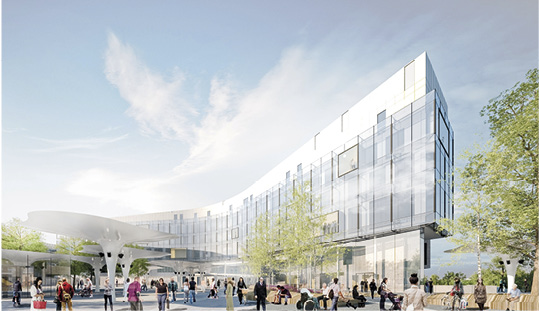
Vienna North Hospital, piazza
Countries in Scandinavia and the Nordic region, many of which came out relatively unscathed from the deep recession, are in suitable shape to make good on the ‘health is wealth’ promise. And, while the trend to build smaller ambulatory care and day-surgery facilities closer to local communities is unlikely to see any dwindling in the near future, there are other forces at work, with a realisation that locating testing and treatment services close to associated academic and research facilities can not only provide a faster and more efficient acute-care service but might provide more opportunity for career progression and aid staff retention, while acting as hubs to connect local GPs to specialists.
Nowhere is this more evident than in Denmark, a country which, according to Christopher Shaw, senior director at Medical Architecture, is “powering ahead in restructuring its acute and psychiatric infrastructure with eight new super-hospitals, each serving a population of around 700,000, which combine academic and biotechnology research – a major plank in the country’s planned economy”.
He continues: “The UK, Denmark, Sweden and parts of Spain are particularly interesting in that they are all, in different ways, linking public health investment with tariff-based health.” Broadly, this manifests itself in healthcare design by “elevating public health benefits within the planning systems, as in Denmark; greater integration of health maintenance and intermediate care facilities with social infrastructure, as in Sweden; and concentration of, and removal of tiers in, secondary and tertiary-care facilities into much larger acute academic hospitals Europe-wide”.
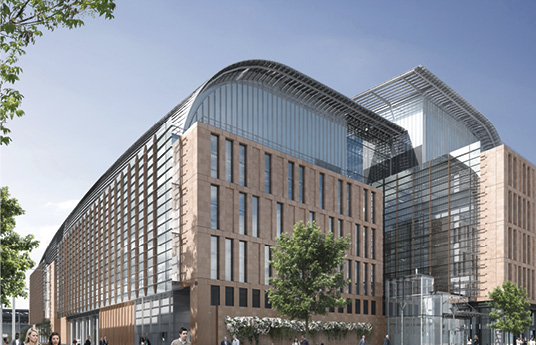
The Francis Crick Institute, staff entrance
Supersizing strategy
BDP has won the masterplanning project for the design of a new hospital complex in the Bispebjerg suburb of Copenhagen. Due to be complete in 2025, it will feature 94,000sqm of new buildings and the renovation of a further 64,000sqm on a 26-hectare plot. Stantec’s Jonathan Wilson questions the extent to which this vast campus is embracing integration across the various tranches of the ‘care pyramid’, suggesting that it appears to be “focused exclusively on acute care”. But, in deliberating that it may be tailored to the needs of Denmark’s relatively small and dispersed population, he points out that it could be imitating Northern Ireland, which has established a distributed network of local hospitals and community or primary-care centres.
Indeed, he praises the UK as a country that “has got this right, despite being dogged by procurement straitjackets, which are expensive and/or inflexible”. Adopting a more ‘glass half-empty’ stance, John Cole CBE, former chief estates officer in the Department of Health, Northern Ireland, says: “In the UK there is very much a need for regional planning to develop the chains of hospitals collaborating in a way to ensure they are delivering an integrated and comprehensive range of services.”
Stephen Herbert, senior project architect at HOK, is confident that the Danish supersizing approach is the other side of the same coin that is seeing the delivery of care brought closer to local communities. “It goes beyond the provision of large, acute hospitals and is filtering down to ambulatory and community care,” he says. “It’s helpful if you have policy-makers who are more joined-up in their thinking and are rethinking their overarching strategy, rather than tinkering around the edges.”
And Kirsten Ziemer, a medical planner at HOK, says Scandinavian countries are leading in their approach to preventative healthcare, by teaching healthy lifestyles in schools. “In Finland,” she says, “what they have seen is children going home to their parents with information about healthy lifestyles and healthy eating that the adults weren’t knowledgeable about. So there is this filtering up of education as well.”
This peer pressure in reverse may be a happy coincidence, but it could form a vital cog in the transition to healthier living, with European nations faced with ageing populations burdened with multiple chronic diseases. Highlighting the progress made by the Finnish in this regard, Ziemer recalls her experience of visiting a social centre where elderly people, some of whom are in their nineties, participate in group activities.
For Guido Messthaler, managing director of HDR TMK, the key word is ‘sustainability’. In order to maintain an active lifestyle into old age, the patient’s situation must be strengthened,” he explains. “The magic word is self-reliance.”
Highlighting the example of one of his firm’s projects, an outpatient clinic for naturopathic medicine in Essen, Germany, he adds: “By visiting the outpatient clinic, patients stabilise their own health sustainably for the long term. The Clinic for Naturopathic Medicine, which belongs to the Essen-Mitte Clinics, is the first hospital in Germany to offer its patients such comprehensive day-clinic care.”
Schwarzwald-Baar Kinikum, Villigen-Schwenningen, Germany
The Schwarzwald-Baar Klinikum illustrates how the context of a country’s healthcare system can determine the design of space. Germany follows a universal multi-payer system, and most new hospitals include a mixture of both double and single rooms. Schwarzwald-Baar Klinikum includes three room types: double-bed patient rooms with modest finishes are given to patients with public insurance; double-rooms with high-quality finishes are for patients with private insurance; and single-bed rooms with luxury finishes are given to patients paying in cash.
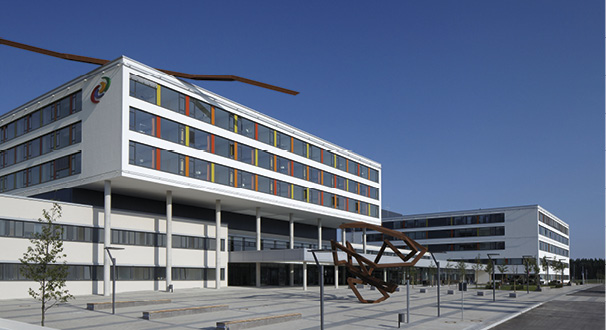
Local design influences drove the design aesthetic of the hospital. The exterior of the hospital stays true to German modernism, featuring simple forms, cubic shapes, and a white façade with yellow, red and orange accents. Art in healthcare environments typically leans toward landscapes and realism, but this hospital celebrates Germany’s influence on contemporary art: the exterior features two large steel-rod installations; an interior corridor boasts a 650-feet-long mural comprising abstract scenes, cartoon strips, and bold colour applications; and 10 individual neon-light nodes, intended to be experienced as clouds of colourful molecules, are suspended in the atrium.
Client: Schwarzwald-Baar-Klinikum Villingen-Schwenningen Gmbh
Architects: HDR TMK
Size: 45,000sqm
Cost: €263m
Completion: 2013
Function and flexibility
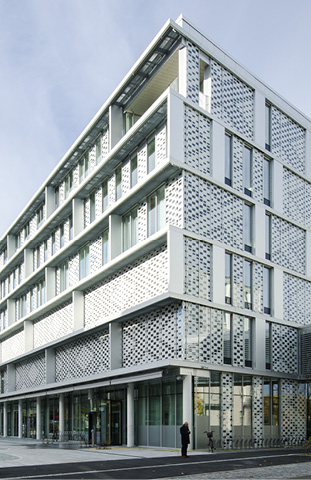
Christopher Shaw points out that Norway’s vast sovereign wealth fund provides it with the freedom to continue to develop. Arguably, the country still boasts the most modern hospital in Europe: St Olavs Hospital in Trondheim. The project, which began in the mid-1990s, has now come to an end with the completion last year of the Knowledge Centre. Designed by Ratio arkitekter, Nordic Office of Architecture and COWI, with a strong emphasis on functionality and usability, the Knowledge Centre will provide facilities for both St Olav’s Hospital and the Norwegian University of Science and Technology. Among the building services are outpatient rooms, laboratories, isolated bedposts, a ward, a library and auditoriums. It has been calculated that the centre’s average energy consumption will be a staggering 45-per-cent lower than the official required standard.
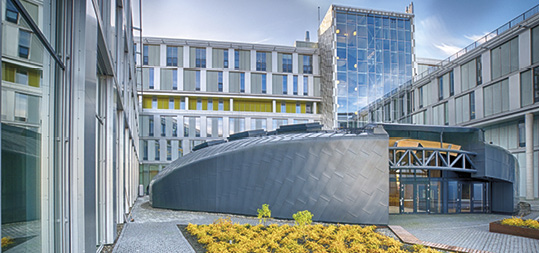
St Olavs Hospital Knowledge Centre, Norway
The main hospital provided a watershed moment in healthcare design in Scandinavia, with its notion of ‘sengetun’ or single-bed rooms grouped into mini courtyards, with direct observation from decentralised workstations. The benefits have been wide-ranging, including a less noisy environment; the ability for physicians, health professionals and students to communicate more easily and carry out examinations in the patient room; quicker patient access to staff; improved privacy; a sense of safety and empowerment; and less anxiety among patients with dementia.
Marte Lauvsnes, a researcher in Norway’s health department, explains: “This concept, which is very flexible, is what many projects are looking for to accommodate future change. It combines both the flexibility of the building for the future and also the human touch of patient-centred care.”
Meanwhile, at the acute level, the acknowledgement that as people age they are more likely to suffer from multiple conditions is conspicuous in a move to combine related areas of medicine. “Hospitals will be forced to think about how to use diagnostic areas in flexible ways,” says Lauvsnes. “Radiology and surgery facilities, for example, are beginning to merge now, and we are seeing more hybrid theatres.”
 |
|
St Olavs Hospital Knowledge Centre, Norway
|
Link in a chain
John Cole takes it a stage further by suggesting that, as much as technology, the flexibility to cater for an ageing population at a much lower cost base is driving the concept of ‘the hospital without walls’, and, for this reason, there will be a need in the future for “a much closer relationship between hospital specialists and people working in the community”.
Realistic that it may be necessary for the hospital to become more dehumanised in one sense, he says: “The future is going to be about more and more computer-driven surgery, which allows more interventions in and out in a day. We need to plan for expansion and flexibility, and the hospital as a factory is going to involve faster throughputs, highly specialised services, and it may not be a particularly enjoyable environment for doctors.”
But there is still room for utopian visions and, in the UK, several recent projects in the field of cancer treatment could be an indication of a new era of humanising care. New patient-focused havens for the famous Maggie’s charity are in development – including one in Cardiff and another in Forth Valley, Scotland – while, at an urban level, there is the ongoing development of highly advanced centres that not only marry related diagnostic units and treatment services but also integrate core research facilities.
One such project is the London-based Francis Crick Institute, which will be complete next year. Designed by HOK in partnership with PLP Architecture, this inter-disciplinary medical research institute will explore how disease develops and find new ways to treat, diagnose and prevent illnesses such as cancer, heart disease and stroke, as well as infections and neurodegenerative conditions.
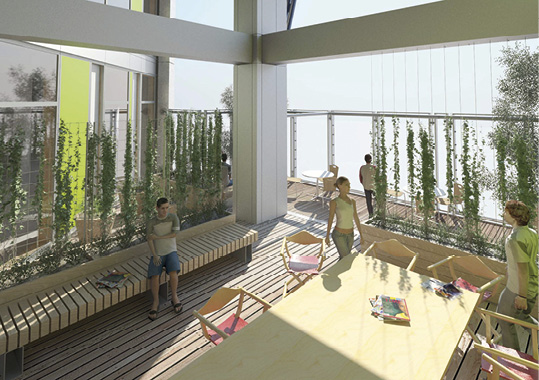
Hospital gardens at Kings Healthcare Partners Cancer Centre at Guy's Hospital, London
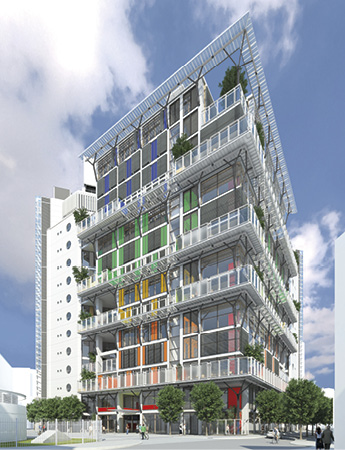 |
Kings Healthcare Partners Cancer Centre for Guy's Hospital, London
|
Another major London project is Kings Healthcare Partners Cancer Centre for Guy’s Hospital that is due to open in 2016. Three heavyweight firms in construction and architecture – Laing O’Rourke, clinical design specialist Stantec, and the world-renowned Rogers, Stirk, Harbour + Partners are collaborating on the project, having been appointed last year following a contractor-led RIBA design competition.
“The client’s brief was fundamentally to bring all cancer care and treatment services together in one building,” says Ivan Harbour. “Our response to that brief in terms of floor area was to go up quite a long way. But with 15 floors, we were concerned that wayfinding in the building would be dependent on signage and there would be a disconnect floor by floor. Our proposal was to break the tall building down into a series of small buildings based on procedures.”
Within the building there are three areas arranged as ‘care villages’ on a human scale: a radiotherapy village, a one-stop village, and a chemotherapy village. Each village is entered via a ‘village square’, with accommodation arranged on mezzanine levels, so visitors can look up and see where they need to go.
Each village will also have a distinct identity incorporating landscaped balcony gardens. This approach not only allows greater flexibility within what might be considered a restrictive patient tower building, but it allows each village to function at both an individual and joined-up level. Jonathan Wilson points out that the villages embody the warm and relaxed character of a Maggie Centre. “This kind of approach requires a shift of attitude to spatial planning, interior design and furniture selection – in other words, a completely different type of interior space,” he says. “Stantec has taken this philosophy right into the treatment zone, rethinking, for example, the layout of a standard consulting-examination room to foster more equal relations between patients and clinicians.”
Harbour adds: “There is a feeling that wherever you are, you are at the bottom of the building rather than the top. This allows the spaces to establish themselves independently. We knew we were reacting against the conventional and against the traditional institutional environment that relies on corridors and corridors, and lots of signage. We wanted to rely more on space and light.”
AZ Zeno hospital of Knokke-Heist, Belgium
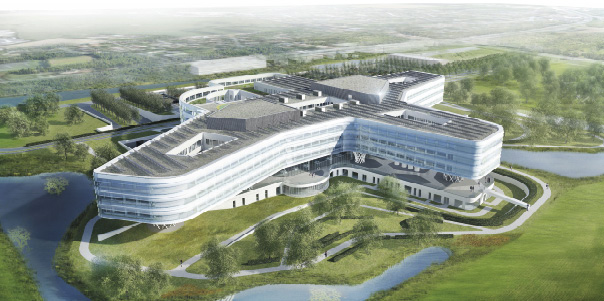
At this hospital currently being built on the Belgian coast, architecture has been elevated to foster positive psychophysical experiences and forms an integral part of the healing process. Sustainability is a major driver in the design of this hospital for the non-profit association AZ Zeno. All rooms will be designed for optimal visual comfort and will oversee a golf course.
Indoor-climate comfort class B will be achieved by cooling and heating ceilings, via a borehole heat-exchanger system. The building’s outer shell is a high-performing double skin façade, while the large windows will be shaded by internal adjustable blinds, providing a high solar factor in summer and a high level of light transmission during winter. Central heating production involves a biomass boiler, cogeneration and a fluid-fluid heat pump exchanging the simultaneous flow of heat and cold. Air-handling units with a double heat-exchanger system help control the air quality, while on the roof, sustainable electricity is produced by use of photovoltaic cells.
Consortium: TA Aaprog – Boeckx
Architects: BURO II & ARCHI+I
Sustainability advisors: Ingenium nv
Structural engineers: Greisch nv; SCES nv
Size: 48,811sqm
Cost: €100m
Completion: 2017
Suspending and sustaining
This departure from the hospital as an institution is really starting to gather momentum in other parts of Europe, too. Sitting close to the Belgian coast, a new hospital at Knokke-Heist is under construction that appears to be suspended over the countryside, with natural light penetrating all the way into the technical rooms.
Led by design firm BURO II & ARCHI+I in partnership with a temporary association of architects, the vision for the hospital is one of allowing the landscape to flow beneath the building. The effect of this is to provide a virtually seamless link between indoors and outdoors, and between care facilities and public areas (see case study).
Other hospital projects are formalising their response to green planning and sustainability by considering criteria early on in the design process and applying life-cycle costing. At the outset of the project to build the new Vienna North Hospital, a Sustainability Charter was developed, drawing upon a workshop held with experts and the project team, and a number of established green building standards. The Sustainability Charter will be extended to cover the operational phase of the hospital and will also serve as a checklist during the planning and construction phases (see case study, right).
East and south
While such objectives are commonplace throughout Europe, Christopher Shaw contends: “The degree of design leadership largely depends on the level of investment in change, and [currently] that is very constrained in Eastern and Southern Europe”. The appetite for building capacity is high in Eastern Europe at present, says John Cole: “In countries like Poland and Hungary, for example, they are going to need significant investment, even though they don’t have the funding at the moment. I think European structural funds will come in to support that.”
Guido Messthaler concurs, saying: “Further potential for growth can be found in the healthcare markets in Eastern Europe. In the Lithuanian capital Vilnius, for example, we built a medical diagnostic center. But I also see a lot of movement in Poland right now.”
The differences in approaches being taken in Eastern Europe compared with the West stretch further than at a mere quantity level, not least in relation to elderly care. Allison Wagner, HOK’s regional director of healthcare, says: “In Russia, they are asking for additional beds than are needed, because elderly patients are going into hospital for two or three weeks a year as they want to socialise.”
Southern Europe, meanwhile, remains bogged down in debt and austerity, although Stephen Herbert believes it may re-emerge in time. “In Southern Europe there is currently less investment. Partly, that is because a lot was built in the early 2000s, and there is a level of slack that needs to be taken up. They have overprovided to some extent, but once that slack is taken up we could start to see healthcare provision requirements surface again.”
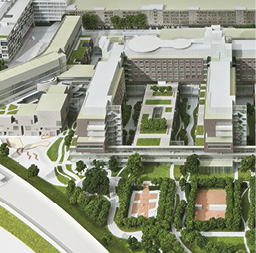 Vienna North Hospital, Vienna, Austria Vienna North Hospital, Vienna, Austria
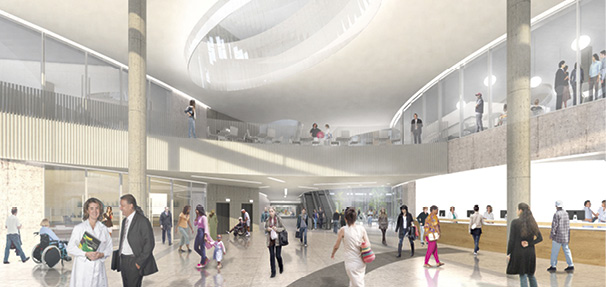
The design for this high-tech building in the Austrian capital combines the advantages of a pavilion-type facility with those of a central hospital. The foyer area features a spacious piazza connecting the hospital with the urban space while, at the same time, providing protection against noise.
Coming from Brünner Straße, visitors first reach an urban square, the boundary of which is marked by the two buildings ‘Mars’ and ‘Venus’ and the service provision wing to the north. The 800-bed hospital, which features single and twin rooms, is horizontally and vertically structured into three parts. Horizontally, it comprises the service provision wing, the core hospital, and a park with therapeutic gardens; vertically, the inpatient wings are located above the promenade deck, which is built on top of the core hospital.
Light-flooded atriums, roof gardens and the overall landscape design unite the ideas of well-being, healing, growth and recovery. The overall concept provides clarity, optimal functional processes, a clear organisation, short distances for the nursing staff to get to the patients, and complex networks.
Client: Vienna Hospital Association
Architects: Albert Wimmer Associates and KHN Health Team
Size: 111,579m2
Cost: €85m
Completion: 2016
Vienna Hospital Association
Procurement plight
As for procurement, while there is uptake for PPP in Ireland and new EU member states such as Poland, the UK is experiencing something of a backlash. Christopher Shaw summarises: “The fundamental problem with a PPP hospital is the lack of risk transfer and consequential rigidity.”
John Cole is vehement, at times, in his criticism of the PFI approach, arguing that it has led to a transfer of influence into the hands of an artificial client, namely the contractor, who has little incentive to focus on the long-term efficiency, operation and adaptability of healthcare structures during the design and build process.
But other commentators believe more PPP projects will come on board because of the intense pressure on costs and need to generate earnings. Says Guido Messthaler: “In Bad Homburg and Usingen, we just celebrated the opening of two new hospitals – the Hochtaunus Clinics are the first PPP project in Germany. According to a feasibility study for the Hochtaunus Clinics, there is a potential for municipalities and states to save costs in eight-figure amounts spread over the entire contract period of 25 years. Those are considerable amounts for municipalities, should they in fact materialise over the years.
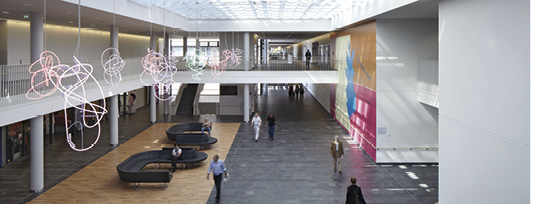
Schwarzwald-Baar Klinikum, Villigen-Schwenningen, Germany
“The German market for hospitals is changing; competitive pressure is growing. Closures, takeovers, privatisation, and the establishment of for-profit service-provider chains and network solutions for independent non-profit and municipal providers are the order of the day.”
Commenting on the lessons learned from 20 years of PPP in the UK, Jonathan Wilson says the model’s commercial incentives are not conducive to design quality seen in terms of the built environment’s positive impact on health. “It is an open question as to whether enlightened clients will continue to adopt PPP as a procurement method for this reason,” he remarks. “It is telling that major city-centre NHS trusts, particularly those in London, which can raise finance in alternative ways, avoid PFI.”
He adds: “Project agreements must allow providers to devise and implement changes to their estate in a natural and flexible manner as needs arise, and certainly without the concessionaire imposing unreasonable costs. If PF2, the new generation of PFI currently being rolled out in the UK, cannot do this, it will not survive.”
Andrew Sansom is associate editor of World Health Design
|

1.1.jpg)



|