Eastern Promise
|
Medicover Hospital, Warsaw
|
| Cost: |
£13 million |
| Client |
Medicover |
| Consultant |
Arup |
| Health Planners |
Tribal
|
| Structural Engineer |
Arup |
| Services / Environmental Engineer |
Arup |
| Landscape Architect |
Atelier 7 |
|
The modernisation of healthcare facilities and reform of the healthcare sector is gaining pace in Russia and Eastern Europe. Kathleen Armstrong looks at recent developments and the challenges and opportunities they provide.
It has been 17 years since the collapse of the Soviet Union, but it is only now that the rebuilding of the healthcare sector in the countries of the former USSR and Eastern Europe is really beginning to get under way. Years of neglect have left buildings in a poor condition, impacting on patient care. And as they look for ways to modernise, architects and construction specialists from around the world are looking at how they can get involved.
During the Soviet era, health was not a priority and investment was low. At the same time, there were large numbers of small hospitals. The primary care sector was relatively undeveloped, hospitals were often disease-focused and there were parallel health systems for specific sectors, such as the army, the police or transport, each with their own set of hospitals and medical care.
In the USSR, funding was focused on bed numbers rather than the care provided. This, says Bernd Rechel from the London School of Health and Tropical Medicine, led to unnecessary hospitalisation and an inefficient use of resources. In its 2004 report on healthcare in the Ukraine1, the European Observatory on Health Systems and Policies said: “Despite the limited resources available for the healthcare system, planning continued to be oriented towards the goal of ever-increasing capacity, measured by the number of hospital beds and of health personnel.
|
| The 16,631m2 Medicover Hospital brings UK and Polish design standards together in a modern facility |
As a result, Ukraine, as many other former Soviet republics, had one of the world’s highest numbers of hospital beds and physicians per capita. Inevitably, increased quantity was at the expense of quality, and in many cases encouraged harmful practices such as lengthy hospitalisations for minor disorders.”
Under-investment in facilities meant that some hospitals in rural areas didn’t even have basic amenities, such as running water or sewerage2. After the fall of the Soviet Union, most of the countries in the former USSR and in Eastern Europe fell into a period of economic decline and, as a result, healthcare suffered further. In Russia, the “worsening economic situation in the 1980s and 1990s led to a slow deterioration in services, as equipment became antiquated or needed to be replaced, drug stocks dwindled and the fabric of buildings decayed”2.
A mixed story
Countries in the region are now stepping up investment in the sector. Funding is most secure in Russia and Kazakhstan who are reaping the benefits of the oil boom and, therefore, have more funding available to invest in new facilities.
However, for other countries in the region budgets are more insecure and progress has been slower. Funding to support infrastructure development has come from a range of sources, including the European Union, the World Bank, the Islamic Development Bank and the World Health Organization. However there are many other areas of infrastructure in each of the countries that desperately need attention and are also laying claim to the funds, so resources are limited. So, many countries in Eastern Europe and the former Soviet Union are now looking to the private sector as a way to fill the gap.
In Romania, the government announced plans in May 2007 for the construction of 20 country emergency hospitals and eight regional hospitals3. Procurement procedures for the facilities were originally planned to be finished a year ago but they have only recently been completed. Once construction begins, the government says they will be completed in 18 months.
|
| The WGI-designed Swissmed hospital in Warsaw |
In Bulgaria, there were only 18 hospitals in the country in 2000. By 2007, there were 71 new hospitals and another 80 are expected to have opened by the end of 20084. The government has a policy of public-private partnerships and at the beginning of this year approved the full privatisation of hospitals.
Georgia has also privatised its healthcare sector and all but four of the 254 state-owned hospitals have now been taken over mainly by healthcare and real estate companies, on the proviso that they will be refurbished and will not be converted to any other use for a period of seven years. According to a report in Pharma & Healthcare Europe5, fewer than 30% of the country’s 16,455 hospital beds are currently in use and the government is aiming to eventually reduce the number of hospitals in the country to 100, restructuring healthcare to a system with less specialised and more general hospital care.
Private inroads into Poland
In Poland the switch to private healthcare is also well under way. Construction of the first private hospital since EU accession began in June 2007 with €30m investment from medical services company Medicover. Colin Hockley, managing director of Nightingale Associates which designed the facility, said the hospital is targeted at “the inhabitants of Warsaw and other insured customers”.
Nightingale’s health development director Kieren Morgan said the building is designed to be non institutional, in contrast with existing state provision. Medicover wanted the hospital to provide a welcoming atmosphere and exude clinical excellence. The design also had to incorporate flexibility to allow for eventual expansion.
Polish architectural firm Atelier 7 took over the technical design of the project to ensure that it met local regulations – it was a requirement of the Polish government that a local firm become the ‘legal author’ of the development. Hospital wards in Poland, Morgan said, are often self-contained entities, each with its own facilities. The Medicover hospital, however, will be structured more around international models, with a separate operating theatre department and diagnostics that cater to the whole hospital rather than an individual ward.
|
Swissmed Hospital, Gdansk
|
| Cost |
70,000,000,00 PLN |
| Client |
Swissmed Centrum Zdrowia |
| Lead consultant |
ARCHstyl Maria Podwojewska |
| Contractor |
POLNORD |
| Architect |
Watkins Gray International LLP |
| Landscape architect |
ESTA Jolanta Bogucka-Delezuch |
| Construction management |
Jacek Swigost |
|
The Swissmed general hospital in Gdansk is another response to the perceived need for private healthcare. Designed by WGI Architects, the 75-bed hospital will cater mainly for international companies who provide private health insurance for their employees. The design includes natural light and healing gardens, incorporating many of the values of evidence-based design – a movement that has yet to take a real hold in countries with emerging economies like Poland where trying to find ways to fix basic infrastructure and crumbling architecture on very limited budgets is more of a priority.
The Gdansk facility was constructed before Poland’s accession to the European Union (EU), opening in January 2004, and WGI is now designing two further hospitals for Swissmed – one, a larger modern hospital in Bratslav and the other in Warsaw.
WGI partner Chris Pye said the design had to include enough space in patient rooms for visits by relatives and extended family, as well as the development of mixed-use hotel-type accommodation adjacent to the hospital that could be used by patients’ families and by passing trade.
State hospitals, Pye said, are often impoverished and crumbling, badly in need of repair. At the same time, there is a growing middle class in the country who are willing to pay for a higher level of care and access to better facilities.
Russian regulations
It is a similar situation in Russia, where the private sector has also begun to take hold. However, the process of complying with regulations, especially for projects that move beyond the traditional, can mean projects are delayed, often for extended periods of time. And for non-Russian architectural firms and other companies wanting to design and build facilities that go beyond the norm, it can be a steep learning curve.
|
Moscow Medical Center
|
| Project cost |
$95m |
| Construction cost |
$75m |
| Client |
CMI Development |
| Architect |
NBBJ |
| Structural Engineer |
Korda Nemeth |
| Landscape Architect |
NBBJ |
|
|
|
Up to now, much private sector development has focused on small private clinics retro-fitted into existing buildings. But a number of commercial developers are planning more ambitious projects, large hospitals that will offer a full range of care. When planning first began for CMI Development’s Moscow Medical Center, the aim was to become the first ‘western-style’ hospital in the country. The standalone facility was designed by NBBJ Architects in Columbus, Ohio who began working on the project in 2002.
Architect Tim Fishking said one of the main challenges was to learn how the regulatory process worked, how to successfully marry international best practice with Russian regulatory requirements. English translations of the regulatory requirements – the SNIPS and norms – were difficult to obtain and trying to get approval from the regulatory authorities for standards that were outside the Russian norm was often difficult. To help facilitate the approval process, CMI Developments brought representatives from the regulatory agencies to the US, to visit facilities with a similar vision.
The standards that were the main sticking points, Fishking said, were related to the physical architecture – such as plumbing, quality of air, power and water. Eventually, approvals were given and construction on the project began.
However, construction came to a halt when many of the approvals that were verbally agreed were reversed, and it remains only partially complete. Whether it will be used in the end for healthcare or put to some other use, he is unsure as NBBJ is no longer involved in the project. Fishking said NBBJ learned a lot from the process, which it will not only apply to future projects in Russia but some of which it is also applying to projects in the US, including standards which Fishking originally thought were old-fashioned but learned to appreciate during the process.
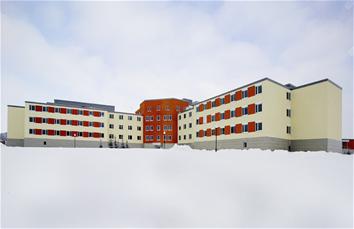 |
Penza Cardiology Centre,
Russian Federation
The 19,000m2 cardiology centre in Penza in Russia’s
southwestern region includes a three-storey main building and four-storey Y-shaped wing. Large expanses of glass and colours give structure to the building’s varied exterior. Facilities in the 185-bed unit include three operating theatres, 40 intensive care beds and two angiography rooms. It is one of 14 modular facilities constructed for the Russian government by Cadolto, which have been developed to meet the needs of local populations, according to assessments carried out by the government.
|
The process was smoother for Cadolto, which worked directly with the Russian government on the construction of 14 specialist medical centres around the country. The company, which specialises in modular buildings, had a tight deadline in which to deliver the facilities but chief operating offi ce Dr Bjo¨rn Werner said the ability to provide a quick turnaround was one of the reasons why modular construction was chosen for the projects.
Constructed in the Cadolto factory, when they leave to be transported to the site, they include all medical, laboratory and building technology, sanitary installation, tiles, fitments, equipment, as well as the fac¸ade of the building. Initial discussions about the project first began in 2005 and the first seven fully equipped pre-fabricated modules, each of around 19,000m2, had been delivered by June 2008. The remaining seven are due to be ready for use sometime in 2009.
The facilities will comprise traumatology centres in Krasnodar, Cheboksary, Smolensk, Barnaul and Vladivostok; cardiosurgery centres in Chabarovsk, Krasnoyarsk, Astrakhan, Penza, Kaliningrad, Perm and Chelyabinsk; and neurosurgery centres in Tyumen and Novosibirsk.
The modernisation of healthcare facilities and reform of healthcare delivery throughout Russia and Eastern Europe is gaining momentum. Canada’s Zeidler Partnership is in the initial stages of discussion about the design of another new private hospital in Russia and WGI, NBBJ, Nightingale and other architectural firms are exploring opportunities in Romania, Hungary and other countries of Eastern Europe. The challenges remain high, but the opportunities are great.
Kathleen Armstrong is a health writer
References
1. European Observatory on Health Care Systems. Healthcare Systems in Transition: Ukraine. 2004. Accessed at www.euro.who.int/Document/E84927.pdf
2. European Observatory on Health Care Systems. Healthcare Systems in Transition: Central Asia. 2002. Accessed at www.euro.who.int/document/Obs/0335209262.pdf
3. Guineva S. Hospitals: the next hot thing? Sofi a Echo. 5 Sept 2008. Accessed at http://www.sofiaecho.com/arti /property-focus-hospitals-the-next-hot-thing/id_31557/catid_23
4. Romanian Hospitals Need to Comply with EU Standards by 1214. Mediafax.ro. 9 Sept 2008. Accessed at http://www.mediafax.ro/engleza/romanian-hospitals-need-to-comply-with-eu-standards-by-1214.html?6966;3155631
5. Completing the Switch to Private Healthcare. Pharma & Healthcare Insight. June 2008. Accessed at http://www.pharmaceuticalsinsight.com
|

1.1.jpg)







|