Technology: Concert of Care

Dr Eve Edelstein visits Palomar Pomerado Health to see how the US healthcare provider is integrating leading-edge medical and information technology into its design for the hospital of the future of care.
As hospitals grow ever larger and care serves an increasingly acute patient population, a new range of technologies is being sought to enhance care and transmit medical information within and beyond hospital walls.
This movement explores systems that function simultaneously at internal, individual and global levels. Information technology and microelectronic systems are being developed to transmit patients’ vital signs and physiological states so that triage can occur before the patient reaches the hospital, at the same time as enabling access to medical expertise around the globe.
As scientists develop microtechnologies that monitor the health status of people in the most extreme environments, whether in space flight or on the battleground, we can expect to have these technologies trickle down to our homes and public places. In hospitals, it will enable timely and continued logging of patient status that can be accessed by caregivers on site and remotely.
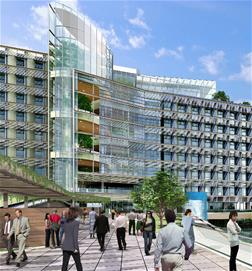 |
The terrace at Palomar Pomerado Health's
'Hospital of the Future' |
Hospital of the future
Palomar Pomerado Health (PPH) in Southern California is looking to incorporate such technologies, building an innovative healthcare system for the seven communities and outlying areas it serves in northern San Diego County, the largest public health district in California.
With expenditures of approximately $1.2 billion, PPH will build a hospital of the future, a 450-bed tertiary medical centre that will replace its current hospital in downtown Escondido; double the size of its second hospital in Poway to more than 200-beds; seismically retrofit and convert its existing 326-bed hospital in downtown Escondido into a specialised campus featuring mixed-use retail, housing, physical rehab, urgent care, behavioural health, oncology services and administrative offices; and build four major satellite health centres throughout the health district.
These plans are driven by its projection of at least a 30% increase in population with a doubling in the number of those over the age of 65, and an unfunded state mandate that requires acute care facilities to meet earthquake standards. The stated goal of Michael Covert, president and CEO, is to “build the Fable Hospital” described by Berry et al1 , to increase operational efficiency, reduce errors and injury, build in fl exibility, and improve the contribution of architecture to a healing environment. “Throughout this process, we needed to remind ourselves repeatedly that we are not building with today’s technology in mind or even for the innovations of 10 years from now,” Covert said.2
PPH’s process includes evaluations of cutting-edge technologies, including operating suite robotics, remote medical presence via roving consultation robots, personal RFID tracking devices, high-tech patient beds and automated systems that monitor patient health status and movement, LCD image and information panels in each patient room, and patient rooms that can be quickly reconfi gured to support rapidly changing patient needs and advances in medical procedures.
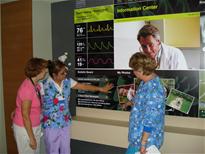 |
Large LCD panels in each patient room provide patients and physicians with the means to concurrently display patient demographics, vital signs and medical information
|
The innovation challenge
A conflict arises when selecting information and high-technology solutions for healthcare environments. Technological innovations and developments occur at a pace that is more rapid than the architectural process. By the time a healthcare facility has been planned, approved, and built, several new generations of technologies may have been tried and tested.
To meet this challenge, Orlando Portale, PPH’s chief technology and innovation offi cer, uses an approach borrowed from systems design philosophy: “Shed burdensome heritage; put everything on the table; come from nowhere; fail early and small; embrace constructive dissatisfaction; change the game; innovate; and act.”
This approach considers not only products readily available today, but also looks to future systems at the ‘bleeding edge’ of technological innovation. This process builds a view of the future that can be used to formulate more informed and educated guesses about changes in architectural infrastructure. Finally, the PPH strategy may include a delay of technology purchases until the last practical moment, so that innovations can be incorporated when the hospital opens in three years.
The nature and risk of healthcare provision poses additional challenges that arise when choosing technologies. The margin of error for medical technologies must be extremely low. An error rate of one may result in one death or multiple injuries. However, old systems impose their own risks. Portale suggests that they can be inefficient; at worst, deadly, including errors in surgical orders, medication dosage or follow-up care.
Testing technologies
Updated information technologies and operational systems are thus being sought to reduce the vast amounts of information permanently lost because of outdated or poorly conceived information transfer and management systems.
Critical to the successful implementation of any new system in a complex, high risk environment such as healthcare, is the testing of technologies by interdisciplinary planning and care teams in clinical units during real-time, real-world healthcare operations or in mock-up conditions.
PPH chief nursing executive, Lorie Shoemaker, recruited staff from across the hospital to participate in a user assessment of design concepts and to test some of the technologies on its units. For example, remote tele-presence is being explored in Pomerado’s intensive care units, using internet and video conferencing via the InTouch Health Kodak camera to review patient results from scans and images.
A novel mobile robot is being tested as a means to provide remote medical presence in several clinical areas.
Dubbed ‘Iris’ because it functions as another pair of eyes, the robot rolls through units and patient rooms, controlled remotely by doctors using a joystick and laptop. Via a high-speed internet connection, the robot allows remote consultation with colleagues, patients and visitors, as if the doctor were in the room. The robot, developed by InTouch Health, can navigate down hospital corridors, rotate 360 degrees, zoom a camera in on a patient’s eyes, or view x-rays or vital sign monitors.
High-technology patient bed monitoring units add to the armament of high-tech devices that support continued monitoring of patient status and needs, supplementing visual surveillance by nurses. The LifeBed, produced by Hoana, uses a non-invasive ‘smart’ fabric on top of the bed to record vital signs, pulse, breath rhythm, heart rate and respiration without any connection whatsoever.
Hoana’s technology transforms any hospital bed into a LifeBed. If the patient begins to deteriorate, the LifeBed immediately notifies the hospital nursing staff. Changes in a patient’s condition identified early, may result in early interventions and positively impacts patient outcome.
LifeBed, reports some hospitals, have reduced falls by as much as 90%.3 Cisco Systems has developed RFID bracelets that will guide patients. Encoded on the band is the patient’s name, date of birth, gender and a medical record number, linked to the hospital network that connects the patient record to labs, billing and to the pharmacy.
Doctors and nurses will be equipped with a tablet-style PC with an RFID reader and a Wi-Fi connection to access the network. The system consists of an integrated RFID application, developed by Siemens Business Services (SBS), which connects the hospital’s electronic medical records, lab systems and billing system. The existing computerised physician order entry system allows for a seamless RFID implementation.
Tablet PCs are embedded with SBS RFID software and used as hand-held readers for RFID wristbands provided by Precision Dynamics Corporation (PDC). PDC’s Smart Band RFID wristbands include a 13.56 MHz RFID inlay from Texas Instruments4.
RFID systems linked to sinks are being considered as a method of alerting clinicians with the sound of an alarm as they enter a patient room to encourage them to wash their hands before contacting the patient.
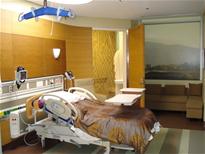 |
Patient rooms have been designed as flexible acuity-adaptable environments
|
Patient room design
Patient rooms for the new hospital have been designed as flexible acuity rooms, based on concepts described by Hendrich et al5. A mock-up has been built for user feedback, demonstrating improvements in surface finishes, headwall design, family zones and accessible shower rooms that add to amenity and patient comfort. The square footage of each room has been expanded from 140 square feet at the present facility to approximately 350 square feet.
Hendrich et al5 reported a decrease in errors and injuries related to the reduction in patient transfers in acuity adaptable rooms, and improved flexibility of use. Their comparison of pre- and post-patient room conditions revealed that as patient transportation was reduced by more than 90%, medication errors decreased by 70% and the fall index for patients in the high-risk cardiac test population fell from six to two falls per 1,000 patient days.
Palomar will track such outcomes, as well as metrics that include costs, quality of care and patient satisfaction in flexible acuity rooms compared to the previous designs. Palomar is modeling scenarios with government regulators and collaborating with an advisory group to ensure that nurses and ancillary staff are appropriately trained for this new nursing model.
The patient room has also been adapted for information systems. As physicians make rounds, large LCD panels in each patient room will provide the means to concurrently display patient demographics, vital signs and medical information.
Patients will be able to remotely control room temperature, order a meal, surf the internet, conduct videoconferences with their doctor, and play music. Patients may also display images, family photographs and possibly works of art from the Museum of Modern Art.
Voice-based fall alarms will not only alert nursing staff to fall risk but also speak to patients using voices recorded by loved ones, gently instructing them to return to bed. Initial pilot studies in functioning clinics were successful, and 51 units have been rolled out in operational units. Ceiling-mounted patient lifts will be installed in all patient rooms, in addition to handrails leading from the head of the patient’s bed to the toilet in order to minimise preventable falls.
Patient rooms are organised into nursing pods with both central clinician stations and distributed nursing stations, providing continuity of care by maintaining good lines of sight between nurses and patients. The hospital plans to track patient, staff and economic outcomes relative to such design changes.
Community engagement
In 2004, seeking broad input from the community, a virtual Palomar hospital was launched on the internet, offering visitors a reproduction of the proposed development.
Developed by Linden Labs, Second Life visitors can tour the site in the form of avatars, moving through simulated models of the facility and learning about proposed technological innovations. Second Life enables a unique opportunity for involvement with an audience. Unlike most traditional web sites, this virtual world platform encourages high engagement.
Other organisations have taken advantage of this 3D interaction space to conduct research and solicit feedback6. Palomar will use this vehicle to model how architectural design and technological interventions may influence workflow7.
What becomes clear from both virtual and mock-up visits is that technology and architecture must work in concert. As the fulcrum of activity in emergency situations, healthcare spaces must remain functioning despite loss of energy or communication bandwaves.
Although backup electrical generators are required, care provision must continue despite their failure. Therefore, architecture must provide adequate sightlines to patients and other staff, and create spaces for communication in verbal and written form as well as remotely.
Accordingly, hospital design must facilitate multiple electronic transfer systems and allow for innovations to be incorporated with minimal physical change. At the same time, hospital design must support the transfer of information from person to person, encouraging information carried in the expression of urgency seen in the eyes above a surgical mask, and the transfer of knowledge and caring provided by face-to-face encounters.
Author: Dr Eve Edelstein MArch, PhD, Assoc AIA, F-AAA is senior vice-president of research and design at HMC Architects and a visiting scholar working with the California Institute for Telecommunications and Information Technology (Calit2) at the University of California, San Diego.
References
1. Berry LD, Parker D, Colle R, Hamilton DK, O’Neill D, Sadler B. The business case for better buildings. Frontiers in Health Services Management 2004; 21(1):3-24.
2. Covert M. The time is now. Health Environments Research & Design Journal. October 2007.
3. Accessed at: www.hoana.com/products.aspx?id+406
4. Schwartz E. Siemens to pilot RFID bracelets for health care. InfoWorld. 23 July 2004. Accessed at: www.infoworld.com/article/04/07/23/HNrfi dimplants_1.html
5. Hendrich AL, Sorrells AK. Effects of Acuity-Adaptable Rooms on Flow of Patients and Delivery of Care. American Journal of Critical Care 2004;13: 35-45.
6. What is Second Life? Accessed at: http://secondlife.com/whatis
7. Palomar West: Hospital of the Future. Accessed at: www.virtualpalomarwest.org Above Top: Patient rooms have been designed as flexible acuity-adaptable environments
|

1.1.jpg)







|