Children's Hospitals: Metaphors for Healing
|
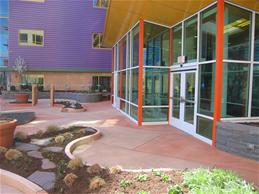
The healing garden, with its quiet spots complete with rocking chairs, tables and benches, is where patients, family members and staff can relax and enjoy the outdoors without leaving the grounds
|
The concept of transformation is central to UPMC’s new family-centred children’s facility in Pittsburgh – a space that is energising, secure and sustainable. Tim Powers explains.
Already internationally recognised for its outstanding clinical services, research programmes and medical education, Children’s Hospital of Pittsburgh of UPMC opened a new facility in May that is a model for paediatric healthcare. Astorino, which created the facility on a 10-acre campus, aimed not only to meet people’s deepest needs but to incorporate practical elements such as safety, security and sustainability into the overall design. The hospital positively impacts the healing process for children, more than 500,000 of whom visit each year.
It’s all about people
To address the innermost needs of patients, families and staff, Astorino used deep design research from its affi liate company, Fathom. From this research, metaphors emerged for the ideal child experience, which then served as design guidelines for the new hospital and are represented in a number of key features throughout the facility.
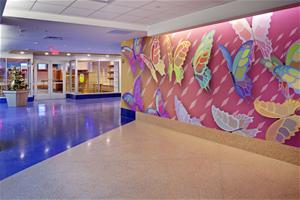
Transformation became the over-arching theme, while control, connection and energy were identified as supporting metaphors. Astorino integrated the underlying theme of transformation throughout the hospital in an effort to guide patients and their families through the arduous process of treatment and healing. It starts before patients even see a doctor, with a walk through the ‘transformation corridor’, a hallway that connects the parking garage to the hospital’s main lobby, where the change in seasons is represented in the floor and an impressive wall mural depicts beautiful butterflies emerging from an Escher-like pattern.
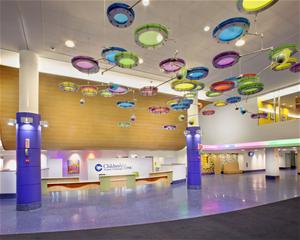
An atmosphere of positive energy pervades both the inside and outside. The inpatient atrium, for example, a central gathering point, can be used for energising activities such as watching educational or entertainment programmes on a two-storey projection screen.
|
Astorino's guiding design theme was the idea of transformation; it created a 'transformation corridor' between the parking garage and the lobby, with colourful flooring and mural
|
Patient rooms were turned into intimate and private spaces that are kid-friendly, allowing children to take control over elements such as lighting and display of personal items. Comfortable, semi-private sleeping areas for parents were created in the patients’ rooms, and intensive care rooms also accommodate sleeping areas and private bathrooms for family members.
A four-storey atrium leads to a 370m2 rooftop healing garden. Patients who might not be able to physically reach this space are still able to see it; the windows in patient rooms above the atrium provide views of lush green plants, the sun fountain and the sparkle of stars and moons embedded in the stone path – fostering a sense of belonging to the world and being at one with nature.
Safety and efficiency: key priorities
Safety and security were also a top priority for both the hospital and Astorino. The standardised patient rooms have the same basic floor plan and layout of furniture, supplies and medical equipment, helping to increase medical efficiency.
The resulting clean and organised workplace eliminates ‘hunting and searching’ and ensures that all materials needed for patient safety are readily available. It also helps to free up healthcare workers to focus on patients’ needs. Proper separation of materials from patients, as well as preventing the overlapping of different patient populations, can also help substantially reduce infection rates.
Astorino therefore used specific architectural features to help manage internal traffic of staff, patients and materials within the hospital: for example, inpatients and outpatients are kept on separate floors, and there are designated elevators that do not allow overlap.
Similarly, separate elevators for soiled and clean materials minimise patient contact with airborne contaminants. Care-team stations offer a spacious work desk where doctors and nurses can clearly see patients while still having privacy to conduct conversations among themselves. This open space promotes a collaborative work environment where medical staff can make smooth transitions between shift changes.
|
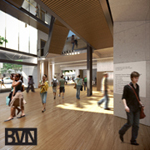
Inherently energising, the lobby set the tone for the building, with its bright colours, artwork, natural light and large and open spaces
|
Adaptable to disaster
In response to the hospital’s disaster preparedness plan, the building was confi gured with adequate soft space for use in the event of a regional disaster. The main lobby, transformation corridor, ambulatory court, undercover driveway and atrium are sized to handle care-giving stations, and the trauma centre can be expanded to accommodate a surge of patients.
Throughout the building, there are ‘rings’ of varying security, with specifi c architectural distinctions and barriers. As the visitor moves through the hospital, they must pass through these increasing levels of security, a system that prevents unauthorised persons from gaining access to sensitive data, access to patients and/or private areas within the facility.
Recognising the relationship between sustainable design and patient healing, Astorino and the hospital partnered to achieve a Leadership in Energy and Environmental Design (LEED) certified design. The hospital’s environmentally sound design and unique approach to the procurement processes for HVAC and low-voltage systems contribute to the overall health and safety of patients and staff, and facilitated the LEED certifi cation process of eligible buildings.
In accordance with the US government’s mandate to digitise healthcare records by 2014, the Children’s Hospital is a paperless facility. This initiative not only saves trees but it also saves staff time, and can greatly reduce patient risk as caregivers have real-time access to medical records, regardless of location.
Wherever possible, construction materials were recycled and local, reflecting the hospital’s commitment to go green beyond traditional means. Other sustainability initiatives include low-VOC materials such as sealants, adhesives, paints and carpets; water-efficient landscaping; air filtration systems that increase indoor air quality; and maximum use of daylight and views.
“We’ve designed and built a hospital that is unparalleled among paediatric hospitals nationwide in terms of its emphasis
on patient safety and family-centred care, its level of technology and its environmental sustainability,” says Eric Hess, the hospital’s vice president and project executive. “From the parking lots to the spacious, private patient rooms, each and every aspect was designed to improve the healing environment and to make patients and their families as comfortable as possible during their stay.”
Tim Powers is senior vice president of Astorino
|

1.1.jpg)





|