Australasia: Space to expand
|
| Gold Coast Hospital Queensland |
Exciting new hospitals are being designed to meet Australia’s growing urban population, mirrored by the redesign of services and facilities in remote, rural areas, while in New Zealand the expansion of healthcare facilities continues. Kathleen Armstrong reports.
Australia’s healthcare system has many layers. A federation of six states and two mainland territories, the Northern Territory and the Australian Capital Territory, decisions about healthcare delivery are in the hands of both state and federal governments. This can lead to some disparity from state to state between healthcare services and the facilities in which they are provided.
Currently, public hospitals are funded by the state governments using a variety of funding methods, including moneys provided to the states by the federal government. Primary care is a responsibility of the federal government. However, the landscape is set to change. In early March, Prime Minister Kevin Rudd announced a series of structural reforms to the country’s health and hospital system, proposing that the federal government take a more direct role in the funding of public hospitals. The government said the proposal would “lead to less waste and duplication and a health system which is sustainable into the future”.
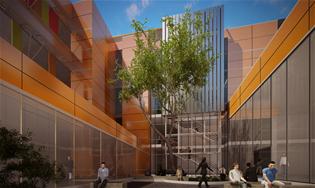 |
| Robina Hospital Expansion, designed by BVN Architecture |
About 30% of healthcare in Australia is provided by the private sector, according to Ian Forbes, director of DesignInc, and about 40% of the population has private health insurance. Private healthcare focuses mostly on orthopaedic, gastro, maternity and other non-emergency procedures and is provided by a handful of profit-making organisations and a smaller number of non-profit organisations (mainly religious organisations), mainly in urban and some regional centres.
With most of the country’s population located in the cities along its coastline, servicing the sparsely populated interior of the country is a challenge. It is particularly difficult to attract staff to remote areas and the small, widely spread populations mean that large complex healthcare facilities would be underused. Some areas may have only a few hundred people. Although the young often leave to work in the cities, the elderly want to remain. The answer has been to develop multipurpose services, or MPSs as they are more commonly known. MPSs offer a range of healthcare services including primary and community care, a number of sub-acute beds and a small emergency/first-stage resuscitation area, and are often co-located with nursing home facilities for the elderly.
The difficulty in recruiting trained medical staff presents a real challenge in the development and design of healthcare facilities in remote Australia. Architectural consultant Peter Kemp describes how the hospital in Young, New South Wales was unable to find anaesthetists to staff its birthing unit so local mothers would travel to Cootamundra, a 45-minute drive away, to have their babies and then return to Young to rest and recover. “Service planning in rural areas is a best guess at the best of times,” Kemp says, “while in cities like Sydney, you know what you can offer.”
Chief executive of health infrastructure for NSW Health, Robert Rust, says distance and the need to service regional centres and provide an adequate level of healthcare is a challenge. Until about 10 years ago, area health services were responsible for local healthcare delivery but then healthcare services were centralised – and in 2007 the health infrastructure board was established as an arm’s length body to oversee the delivery of projects that have been prioritised by NSW Health. These include a range of multipurpose services, cancer centres and the replacement and refurbishment of existing facilities.
Although the NSW government has yet to decide how it will respond to the federal government’s proposed national hospital network, Rust thinks that the proposal could make it easier for states to identify the relevant expertise for healthcare projects – currently widely dispersed in the individual states.
Healthcare infrastructure projects are funded in a range of ways in Australia. The Health and Hospitals Fund (HHF) was set up by the federal government in January 2009 with the aim of funding projects that would meet the government’s health reform targets. The first round was completed mid last year, approving around AUD$32bn of projects. A second round is currently under way, focusing on extending cancer services in remote and regional Australia. The HHF is chaired by Bill Ferris from Champ Equity.
Public-private partnerships (PPP) have been used on four projects so far in NSW, more commonly in Victoria and on a smaller number of projects in other states. PPP is normally reserved for very large projects of over AUD$1 million.
|
Mackay Base Hospital, designed by
Woods Bagot and Billard Leece
|
Managed contractor funding is the usual method of procurement in Queensland, which to date only has one PPP project in planning – on the Sunshine Coast – although that was put on hold during the economic downturn. However, a number of state-funded managed contractor projects are under way. This includes the redevelopment of Mackay Hospital in northern Queensland which will be 80% new build and 20% refurbishment. Gunther de Graeve from Woods Bagot says the project will act as a benchmark, both in futureproofing and in how office space and other services are grouped together.
“We designed the building for twice its size and then peeled it back,” he says. “We know where the new theatres will be, where the lift cores will be – it can change it quite a lot of ways.”
Offices are grouped together in an open-plan configuration rather than being scattered throughout the building and are located in a separate building together with ambulatory care. De Graeve says it is the first zero-office hospital in Australia and it has created a new culture of work “aligned to work rather than to status,” he adds. “It has also made an enormous impact on the budget, reducing it to around AUD$3,000 per sqm from AUD$6,800 per sqm.”
Woods Bagot is also currently working on the expansion of the Princess Alexandra Hospital in south Brisbane. It is also being built with the future in mind – the current development has two floors but allows for another two floors to be added when the need arises.
|
| Mater Mother's Hospital, Brisbane, designed by BVN Architecture |
Mark Grimmer from BVN Architects is working on two hospitals in the region: the Mater, a maternity hospital also in south Brisbane, and the Robina, which is on the Gold Coast. Both have around 80% single rooms and are fully sunshaded with highperformance facades that will significantly reduce energy costs. Water harvesting has been integrated into the design to help save water (the country has suffered from drought for several years). These can be used, for example, in air conditioning systems and toilets.
Futureproofing was also a major factor in both of these projects, locating plant rooms on the perimeter of the sites, using strip window systems and adding toppings in bedrooms to allow for the future addition of en suite bathrooms. David Gilbert from Woodhead Architects is working on the expansion of Ipswich Hospital, just southwest of Brisbane, and Logan Hospital, which lies between the state capital and the Gold Coast.
Both hospitals will more than double in size. Woodhead has also completed the masterplan to guide the future development of the Royal Brisbane and Women’s Hospital which will include tertiary level chronic care, in response to the ageing population in the region (the Gold Coast is a popular destination for pensioners) and the increasing prevalence of chronic conditions.
|
Gold Coast University Hospital,
designed by Silver Thomas Hanley, Hassell, PDT
|
The major project in the region is the state-funded development of the AUD$1.55m development of the Gold Coast University Hospital, designed by the GCUH Partnership (PDT, Silver Thomas Hanley and Hassell Architects. The 1.8 million square foot (165,000m2) tertiary greenfield hospital will have 750 beds and include a range of expanded services including a cancer centre with three bunkers, cardiac, neurosciences and trauma services, neonatal and mental health services, a 65-bed intensive care unit and 20 operating rooms. The facility has 75% single bedrooms, including specially designed bedroom and en suites for bariatric and disabled patients.
The family, women’s and children’s centre, also on the site, is designed around the model of family-centred care, with single rooms for the neonatal intensive care unit, larger rooms in paediatrics and maternity so family members can stay with the patient, and baby baths in all postnatal rooms.”
Aija Thomas from Silver Thomas Hanley says: “The GCUH is unique in terms of its size and complexity. The expertise and capacity required to deliver a project of this magnitude is unprecedented in Australia.”
In South Australia, design proposals for the development of the Royal Adelaide Hospital are currently being put together for the project. However, until the final design is selected, the project is bound by confidentiality agreements.
Already under way is the redevelopment of the 30-year-old Flinders Medical Centre in Adelaide, which will incorporate the latest models of care, according to Woodhead’s David Gilbert who is working on the project. Funded by the state, the design will create a better environment for patients, supporting their recovery, and a better workplace. “
In the health service, staff are still expected to work in antiquated places. This will be a revolution in the design of workplaces,” Gilbert says. Both state and regional hospitals are also undergoing redevelopment and modernisation in Western Australia, part of a redevelopment strategy begun in 2004 when the then state government set up the Health Reform Task Force. This has included the $100m redevelopment of Rockingham Hospital south of Perth, the redevelopment of regional hospitals in centres such as Port Hedland, Broome and Kalgoorlie and the expansion and/or relocation of healthcare services in Perth itself. The Perth developments will include the co-location of a number of hospital facilities in order to better integrate and improve services.
|
| Fiona Stanley Hospital, designed by Fiona Stanley Hospital Design Collaboration (Silver Thomas Hanley, Hassell and Hames Sharley) |
The most ambitious of these programmes is the AUD$1.6bn development of the Fiona Stanley Hospital, co-located with the state rehabilitation centre and a private hospital, St John of God Murdoch. Combined they will comprise around 1500 beds.
Stage one of the Fiona Stanley is underway with construction to ground level expected to complete mid this year. Designed by a consortium of Silver Thomas Hanley, Hassell and Hames Sharley Architects, the facility will comprise a full range of services, including diagnostic, cancer, trauma, neurophysiology, cardiology, paediatrics and a burns unit. There will also be 19 operating theatres in the 643-bed facility.
The hospital has been planned around a patient-centred philosophy says Mike Hartfield from Silver Thomas Hanley, with clear wayfinding, lots of natural light and services co-located together. The consortium brought Roger Ulrich on as a consultant in the initial stages of planning to work with them on establishing the key principles of the design.
Victoria has also seen major redevelopment of its healthcare facilities, including the Royal Children’s Hospital, designed by joint venture architects Bates Smart and Billard Leece, to be completed next year. In 2009, Bates Smart completed the masterplan and feasibility study for the Parkville Comprehensive Centre which, in its next phase, will be released as a PPP. Director Sheree Proposch says it will be a “groundbreaking comprehensive cancer centre”, bringing healthcare, research and education together in one facility. Linked to Royal Melbourne Hospital with two bridges, a key goal is to create an integrated, collaborative environment to enable seamless patient care and the translation of research from bench to bedside as effectively as possible. The development, part of the Victorian government’s Cancer Plan, is expected to be completed in 2015.
Stage two of the development of the Alfred Centre in Melbourne also brings research, education and patient care together in one facility, co-located with the elective surgery centre on the Alfred campus. Bates Smart worked on the AUD$180m project with Bayside Health, the Burnet Institute, Monash University Medical School, La Trobe University Faculty of Health Sciences and the Baker Institute/IDI for all of the project phases.
Another major project was the redevelopment of Dandenong Hospital to the east of Melbourne. The hospital caters to a very broad patient profile with a complicated range of emergent issues, including aged patients, paediatrics,
acute patients, mental health patients and drug-dependent patients. Proposch says the design of the new-build emergency department will incorporate appropriate clustering of the different patient groups for consultation and treatment and will improve patient care, patient flow and staff efficiencies and bring “a whole new lease of life to the east end of the campus”.
|
| Maunga Project, New Plymouth |
Across the Tasman, in New Zealand, hospital development is also continuing. Silver Thomas Hanley is working in partnership with Warren and Mahoney Architects on the expansion of Taranaki Base Hospital, Project Maunga. A threestage development is proposed. The NZ$80m first-stage development will see the addition of a west wing which will house six operating theatres (an increase of two), ambulatory elective surgery and procedure services and a new inpatient ward block.
There will be 152 beds, an overall increase of 26. Project director, Ian Grant, from the Ncounter Group says: “The new hospital building will provide a place where patients can be cared for in enhanced comfort and dignity and in an accessible, friendly and caring environment.”
Risk assessment
Silver Thomas Hanley is also working in association with Klein Architects on the new clinical services building project for Middlemore Hospital in Auckland, which is now in the design phase. Construction is due to start later this year. Once complete, it will contain a new 14-theatre operating suite with a sterile supplies department, recovery and theatre admissions and discharge unit – and it will be the only hospital in New Zealand to completely separate acute surgery from planned surgery. The building will also contain a 42-bed assessment and planning unit and an extended critical care complex with a new 18-bed high-dependency unit.
Middlemore has been designed as a category 4 disaster building. Because of the high risk of earthquakes in New Zealand, design codes require buildings containing essential post-disaster functions, such as operating theatres, to be designed to withstand large events without sustaining the significant internal damage, so they can be repaired quickly after a more extreme event. Thomas says this creates significant challenges for designers, in particular allowing for large movements between floors, adjacent buildings and structure to cladding.
Where the hospital is located, in southern Auckland, is home to the largest Maori and Pacific urban population in New Zealand, so cultural references and beliefs have been incorporated into the design, both in the aesthetics of the building and in the flows of the hospital, such as the movement of goods (food, etc) and the tupapaku route (path of the deceased).
Two other projects currently under way in New Zealand are the expansion of Waikato Hospital and the redevelopment of Wanganui Hospital. Architect Marko den Breems from Auckland-based Jasmax is currently working on both.
The Waikato Hospital concept plan identified the need for further expansion of the existing assessment, treatment and rehabilitation department. The new building area will be 7,390sqm over four levels including the plant area, a 15-bed mental health ward for older people, 98 inpatient beds and an outpatients and allied health department.
The building design is based around the following design concepts:
- to preserve the existing character of the site, maximise views
- to and from the site, create sunny sheltered outdoor spaces, provide patient and staff connection to the main hospital campus, and ensure that the building fits with the contours and natural landscape of the site.
The redevelopment is scheduled in stages, to allow the hospital to continue offering its full range of services while work is undertaken. Stages include both the refurbishment of existing areas and the construction of new buildings. So far, work has been completed on the new entry building and the neonatal intensive care unit. Wanganui Hospital is a smaller regional hospital co-located with a private healthcare provider.
The redevelopment involved the consolidation of ICU, maternity, paediatrics, emergency and the private practitioners. Healthcare facility designs in both Australia and New Zealand are guided by the Australasian Healthcare Facility Guidelines, which have been developed by the Centre for Healthcare Assets Australasia (CHAA). Director Jane Carthey says a recent survey of healthcare project directors in New Zealand scored the guidelines good to very good, although improvements were suggested.
The guidelines are used on all public hospital projects in Australia and New Zealand. They are reviewed and updated using a peer review process – there are currently around 15 guidelines in production which will be replaced on the CHAA website when they are ready. The CHAA project has been under way in NSW since 2002 and went national in 2006. Current funding for the project ends at the end of this year. Most projects also use some form of evidence-based design principles to inform their design.
However, medical doctor Prof Paul Barach says there is a lack of meaningful and robust post-occupancy analysis, although this is a problem common to most countries. “There is evidence on how to improve infection control, falls, staff injuries, etc but there is increasing awareness that this is not enough.”
In addition, Barach would like to see more transparency in how buildings are built – to make design plans and processes more transparent. However, this can provide a challenge in competitive procurement processes such as PPP, where confidentiality reigns until all parties have been selected.
Kathleen Armstrong is a healthcare writer
|

1.1.jpg)



|