Africa: Supporting role
Despite its devastating health problems, Africa is making vital inroads towards self-sufficiency, with the private sector playing a key role, writes Emily Brooks.
|
| The OPD atrium at Baragwanarth Hospital facilitates easy circulation |
In June 2009, the International Finance Corporation (IFC) launched a major new private equity fund specifically for African healthcare projects. Over the next 12 years, the Heath in Africa Fund will invest between US$100m and $120m in private-sector health services, from hospitals and clinics to insurance companies and medical manufacturing companies.
“The fund emerged as a result of a study published in 20071, which identified that the private healthcare sector in Africa lacked access to capital, both for loans and equity – people who are prepared to make investments and try and grow a company,” says Scott Featherston, senior investment officer at the IFC.“ If you wanted to maximise your return you wouldn’t invest in healthcare in Africa; you’d maybe invest in communications or IT. Investors are expecting a return, but there is a philanthropic motivation as well.”
Part of a US$1bn programme by the IFC and the World Bank, it represents a new way of addressing Africa’s health problems. Rather than tackling disease or other clinical issues, this package is intended to target some grassroots problems: lack of infrastructure, inequitable systems that fail to support the poor – a far-sighted approach that is intended to sow the seeds of self-sufficiency for African healthcare. “This fund is specifically excluded from providing funds to companies that only serve the rich, but it will be investing in places where a middle class is starting to emerge,” says Scott. “The only way you’re going to set up self-sustaining companies is if they serve a population that can afford to pay something for them.”
|
Bayelsa State Teaching Hospital, Nigeria
Client: Bayelsa State Local Government
Architect: Ngonyama Okpanum & Associates
Project cost: approximately US$30,000,000
Bayelsa State is a fast-growing area in along the south Nigerian coast and a 500-bed hospital is currently under construction to serve its population. With the building’s envelope already constructed, South African architectural practice Ngonyama Okpanum & Associates was contracted in 2007 to undertake the interior fit-out of the hospital and enhance its existing plans. The building takes a semicircular shape, with major departments fanning out from a central ‘hospital street’. Considerable study was made of both the hospital’s needs and human behaviour patterns in order to devise the interior, with key considerations including circulation, wayfinding, accessibility, energy efficiency and flexibility. For example, the admissions ward has been remodelled not just to improve patient flow but also to allow access for paraplegics, with single seating and a lowered admissions counter. The decor focuses on high-quality finishes fit for a modern hospital interior.
|
One of the first beneficiaries will be a still-undisclosed hospital company in Nairobi. By investing a majority stake in hospitals, the fund would effectively have a say in their running, bringing knowledge and expertise of systems and management that can be crucially lacking.
While these far-sighted projects take root, life goes on for Africa’s billion-strong population, many of whose mother countries labour under an unimaginable healthcare burden. HIV/ AIDS,TB, malaria and maternal health are enormous issues, as is a huge disparity between skilled healthcare workers in rural and urban areas and a shortage of healthcare workers overall. Although physical infrastructure is badly lacking in many areas, the vast majority of fatalities are from preventable diseases and new hospitals filled with highly trained staff are not the answer – instead basic, if very widespread, intervention is needed in the form of public health professionals and community nurses who are able to focus on prevention and education, particularly in rural areas.
A recent AMREF scheme saw 1,180 community health workers from 188 Tanzanian villages trained to increase awareness about malaria prevention and the use of mosquito nets. As a result, child mortality in the district dropped from 231 deaths per 1,000 children in 2006 to 195 per 1,000 in 20082.
Generally speaking, governments are overwhelmed by the demand for public healthcare services and are increasingly turning to the private sector to fill the gaps – a huge opportunity. As the IFC found, however, finding investment for those private facilities is the hard part. Its discovery is backed up by a 2007 book published by the World Bank, aimed at physicians or other ‘medical entrepreneurs’ looking to build their own facilities3, which asserts that “a major barrier to the development of the private health sector is the scarcity of long-term capital”.
 |
Humanity for Children paediatric clinic
Client: Humanity for Children
Architect: Sheikh Ahsan ullah Mojumder, Department of Architecture, Bangladesh University of Engineering & Technology
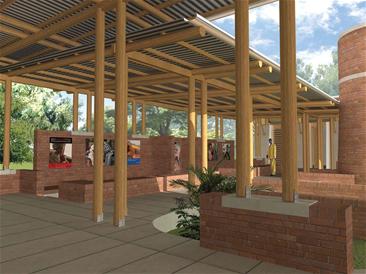
This was the winning entry in the international Architecture for Humanity competition – a paediatric clinic for Humanity for Children, a US- based charity that seeks to eradicate preventable illness in children and their mothers in East Africa. The entrants, of which there were more than 900 from 50 countries, were asked to design a generic clinic that might work across several terrains and locations. Sheikh Ahsan ullah Mojumder’s winning design is based around an open courtyard with a residential block for medical staff. The buildings consist of several modular components that make it easy to adapt the design to steep or flat terrain and are constructed from thick mud walls, timber posts and frames, corrugated iron sheets for the roof and thatched infill walls – materials that are readily available in east Africa. A slight inward taper of the mud walls ensures structural stability.
|
Intended as a step-by-step guide to setting up a new hospital, the book identifies a lack of specialist healthcare architects as a further barrier to building a successful facility and says that those practices without this experience often design hospitals “from the ‘supply side’ perspective.That is, architects work with an eye to what is deemed good architecture, or what will facilitate construction, rather than functionality of design, such as the ease of movements of patients and staff.”
While this may be true for the small-to-medium-sized hospitals being built by entrepreneur physicians, healthcare architectural expertise within Africa is growing, as is the number of external practices working on projects there, usually in partnership with domestic architectural firms. Nightingale Associates has had a Cape Town branch since 2004; the practice has just been shortlisted for work to improve Uganda’s largest state-owned hospital, Mulago National Referral Hospital. Perkins+Will has been active in sub-Saharan Africa since 1999, when it was commissioned to create a new masterplan for Agostinho Neto University in Angola. With the first phase of construction nearly complete, the firm is scheduled to begin a secondary phase involving the university’s medical school and eventually a new teaching hospital.
Bill Doerge, principal at Perkins+Will who heads up its African interests, says: “We’re seeing an increase in [healthcare] activities in most global markets, including Africa, and we are currently talking with groups about healthcare projects in Angola,Tanzania, Kenya, Senegal and the Ivory Coast.”
British architect and healthcare specialist John Cooper, who in conjunction with Sheppard Robson is currently working on early plans for Johannesburg’s Nelson Mandela Children’s Hospital, identifies the biggest barrier of all to western firms working in the developing world: “Our wage structure is twice, maybe three times, that of India or South Africa and their build costs are maybe a third of ours, so we can never compete.Whereas we would normally get 4% of, say, a £100m budget, instead we’d be getting 4% of £30m, but we’d have to do the same amount of work.”
The Nelson Mandela Children’s Hospital only adds up, he says, because of the involvement of two South African practices, Ruben Reddy and GAPP,“who are doing 55% of the work”. Cooper says that from what he has seen in South Africa so far healthcare architects there are “exceedingly good”.
Ngonyama Okpanum & Associates is a practice with four offices in South Africa. It has worked on several high-profile projects, including the fit-out of Nigeria’s Bayelsa State Teaching Hospital (see case study) and a huge overhaul (part demolition, part newbuild and part refurbishment) of Soweto’s Chris Hani Baragwanath Hospital, which, with 3,200 beds, is claimed to be the biggest hospital in the world.
|
| Chris Hani Baragwanarth Hospital courtyard connecting outpatients department with pharmacy and administration |
The practice has a forward-thinking, international outlook that puts research at the heart of every project.“We believe in a ‘from practice to research and from research back to practice’ approach,” says its principal, Innocent Okpanum. “Once you finished something, you have to study your mistakes. Then you know how to improve what you’ve done. And that’s translated into new work – it’s an ongoing process."
Okpanum is passionate about the ‘humanisation’ of healthcare buildings and the process of creating them – whether that means putting a strong emphasis on design guidance, with all the principal stakeholders in a project sitting down to define their relationships and work collectively to establish the needs and functions of a facility, or to banish,for example,shared wards in favour of single rooms, where patients can be admitted, treated and discharged in privacy.
This philosophical approach, which Okpanum picked up during years of study in Italy, is at odds with many of those in his profession in Africa. “Creating symbolic places – and that absolutely includes hospitals – has the ability to change the international perception of a country. Unfortunately, most of my colleagues see architecture as an island: they haven’t really understood that architecture is politics; architecture is economics; architecture is ethics; architecture is values; it is everything.”
Emily Brooks is an architectural writer
References
1. International Finance Corporation, World Bank Group. The business of health in Africa: Partnering with the private sector to improve people’s lives.Washington DC: International Finance Corporation; 2008.
2. Sunny B. Preventing Malaria, Saving Young Lives in Mtwara. AMREF News. Autumn 2009, p3.
3. Nah S-H, Osifo-Dawodu E. Establishing private health care facilities in developing countries: A guide for medical entrepreneurs. WBI Development Studies. Washington: World Bank; 2007.
|

1.1.jpg)





|