Africa: Pride of Ghana
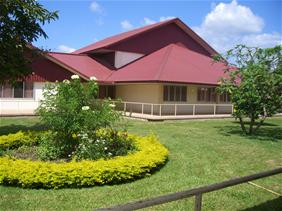 |
The shallow plan of the Sunyani Hospital is responsive to the climate, using an open corridor system, which provides plenty of fresh air and light
|
Peta de Jager visits Sunyani Hospital in rural Ghana, which, despite struggling with overcapacity, is still impeccably run and maintained six years after its completion.
Surrounded by the forests of the Southern Ashanti Uplands of Ghana, Sunyani Hospital is grandly laid out in a beautifully manicured landscape garden, in a neatly walled precinct separating it from the surrounding city. Some 400km north-west of Accra, Sunyani is both a district and regional capital: originally founded in the 19th century as an outpost camp for elephant hunters (it takes its name from the Asante word for elephant), it was declared a district headquarters for the British Colonial Government in 1924.
Today, this low-rise, modest city is home to some 90,000 people whose healthcare needs are served by a 400-bed regional hospital. Designed by Nightingale Associates, a UK-based architecture practice specialising in hospital design for the International Hospital Group, it was funded by £14m of EU money and completed in 2003.
|
The human scale and subtle articulation of the Sunyani Hospital provides a pleasant working environment
|
Infrastructure stewardship
Dr Daniel Asare, ENT Surgeon, and medical superintendant of Sunyani Hospital, has been involved in the project since inception, and with his team has been steward to the facility over its whole life. His role includes steering the design, management and finance of the hospital, including its building infrastructure. This culture of ongoing evaluation and support means that this remote urban hospital is still impeccably well-maintained and run six years after it first opened.
The WHO uses the term ‘Stewardship’ in the context of health systems, but it could logically be adapted to apply to a single facility. Stewardship entails the ability to responsively formulate strategic policy direction, to ensure good regulation and the tools for implementing them, and to provide the intelligence on system performance to ensure accountability and transparency.
Key challenges include balancing the many competing influences and demands across all aspects of health management; establishing clear policy priorities while maintaining an overview of societal interests; and influencing the behaviour of those involved, in a climate of transparency and accountability, through performance assessment and leadership.
Several aspects of stewardship can be enabled (or conversely frustrated and diminished) by architecture and by the way in which the architect’s services are rendered. Stewardship can be enhanced through provision of an infrastructure that is sustainable, context appropriate and adaptable, and can be entrenched through a prolonged commissioning and hand-over process.
A significant feature of Sunyani Hospital was the protracted commissioning and hand-over process of the building. The professional team still provides some maintenance support, and has been involved in managing the outsourcing of specialised services to address routine planned maintenance.
|
The Sunyani Hospital is mainly single storey, making good use of the abundant land available
|
Contextual design drivers
The building typology at Sunyani Hospital is appropriate to the locally available technical and material resources. The complex makes use of local conventional construction methods and materials. Otherwise unassuming brick walls and sheet metal roofing are given accent with a local sandstone plinth detail at the entrance. Design materials and detail specification throughout the facility – such as the spectacular terrazzo flooring – are hard-wearing to address the robust use patterns of public buildings. This is supplemented by a clear management strategy in raising awareness to reduce impact of wear and tear: A triptych of signs (“Do not touch the wall”; “Don’t spit or litter around”; “No smoking”) clearly communicates this.
The hospital also reflects a broader sense of community pride and culture of cleanliness – Sunyani, after all, was recognised as the cleanest city in Ghana for 2007. The structure, being mainly single-storey, avoids the use of imported technology for mechanical lifts. It is technologically modest, relying mainly on natural ventilation via adjustable louvers rather than mechanical ventilation, except in its operating theatres. Ventilation for comfort and dilution (to reduce
airborne infection risk) is supported through ‘shallow’ planning. Rooms are single-loaded onto open corridor systems that are separated by large planted courtyards. Where mechanical ventilation systems have been used, care was taken to specify types that are modular and interchangeable.
Sunyani enjoys a tropical climate; temperatures range from 19 to 35 degrees and rainfall figures vary from 12 to 560mm/month in the wet season. The building is responsive to the climate through its open corridor system, which provides plenty of fresh air and light, and its deep roof overhangs to provide protection from rain and sun. While neither rainwater harvesting nor grey-water systems have been developed in this scheme, the gardens are mostly passively irrigated by rainwater. Storm-water is directed away from the building through a series of hefty drainage channels.
In its sprawling layout, the hospital makes good use of the abundance of available land in the region. The facility hugs the landscape by following the gently undulating contours, and the result is a human-scaled and subtly articulated place. There is some scale differentiation through placement of the administration wing – the only part of the complex to reach two storeys – over the entrance elevation, resulting in a dignified initial impression. This hierarchical aid to legibility and orientation is further formally developed through raising the central portion over the main entrance to accommodate a third-storey water tower.
|
The Sunyani Hospital has seen a four fold rise in doctors and nurses since opening
|
In Ghana , as elsewhere, continuity and leadership – stewardship – is threatened by high attrition, staff turnover rates and the crisis of overburdened healthcare workers, built environment support staff and other personnel. Some evidence suggests that building infrastructure may have a crucial role in attracting, recruiting and retaining staff. At Sunyani, it seems likely that the building supports a pleasant working environment: here, there is an unusually high level of staff retention for rural Arica, leading to a four-fold increase in doctor and nurse numbers during the hospital’s five years of operation.
In particular, the hospital is taking on more and more of a role as a teaching facility, through student attachments. Dr Asare reflects that since opening in 2003, Sunyani Hospital has grown substantially to meet this need. Its investment in human capital development, and in job creation, has arguably not reached full potential because the staff housing that was part of the original master planning has not yet been delivered.
The Ghana government is introducing an energy management drive with targets and disincentives based on a user-pay principle in the near future. This is apt, because apart from growing global awareness around the need for ecological sustainability, electricity is in short supply in the region. Disappointingly, Sunyani does not exploit any alternative or renewable energy sources, but is supplied by the grid with additional emergency generators. Furthermore the impending energy-saving drive will not easily be supported by the infrastructure, because it lacks sub-metering.
|
The hospital's design has coped well with demand since the introduction of a health insurance scheme in Ghana
|
Design for adaption
Although the hospital has a design capacity of 240 beds, it is currently operating at 400 beds. This unforeseen demand is partly the result of the Ghanaian government’s successful policy drive to increase health insurance; this is coupled with Sunyani’s reputation, which appears to mean that it has a wider sphere of influence and catchment basin for which it was designed.
As often is the case in resource-constrained environments, the natural response is to disregard the design bed-space allocation and simply squeeze additional beds between conventional cubicles. Using this sleight-of-hand, the 240-bed hospital has been transformed into a 364-bedder. In less resource-constrained parts of the world, this practice would no doubt raise concern because of the increased risk of cross-infection, but in Africa, it is standard practice. Frequently, in developing nations, this awareness of the implications of not using a facility as it was designed is not fully appreciated, and in the face of dire need, hospitals are pushed beyond the capacity for which they were designed.
Dr Asare is aware of this potential risk issue, and asserts that he uses management processes to address this as best he can, by placing non-infectious cases in those overcrowded scenarios. This cannot account for the 400 beds required, and is a reminder that pressure for provision of beds usually trumps patient safety.
That said, the hospital has survived a doubling of patient demand remarkably well. Apart from the robust material and detailing at Sunyani, one reason for this is that its spatial typology is exceedingly versatile. The hospital complex comprises a system of simple, repetitive planning unit blocks, lacking high degrees of functional differentiation. This loose cast of buildings are linked and provide coherence and a sense of place through a web of covered walkways and large courtyard gardens. The system is easily extensible, and can be adapted to address the future growth of the complex. Indeed, additions have been made, and more are planned, all of which are very much the same as the existing fabric, bearing testimony to the design’s continued relevance.
Several areas are under particular pressure given the uneven growth patterns and demand for particular services. The out-patient and obstetrics departments are the most overburdened, and Dr Asare envisages these becoming satellite entities – still within the enclosed precinct of the hospital complex, but functionally independent.
In addition, the accident and emergency (A&E) theatres are used as theatres for day-to-day surgery. Given that the theatre block comprising five full theatres seems to be under-utilised (at two days per week), and there are complaints about the suitability of the A&E suite (which lacks both a recovery area and a separate scrub area), it raises a question as to why this is failing. One possibility is that trends in medical practice, in Ghana as elsewhere, have seen a shift toward day cases, and away from hospitalisation. As the A&E unit is “closer to the front door”, it may well better support this approach to medicine. Though Dr Asare has some plans for expansion, he acknowledges that the facility will reach an optimal functional size, after which future expansion will become unwieldy rather than realise efficiencies.
|
The hospital's landmark entrance reflects its status as a source of civic pride in Sunyani
|
Design for social cohesion
Sunyani Hospital raises questions about life-cycle costing, and whether the model is comparatively cost-effective: at £14m, this project may well lay beyond the budgets of emerging economies. What is the impact of its increased carrying capacity on the healing environment, and on staff morale? When and how would it be appropriate to replicate this model? Should the model be replicated? Where would it work? How can it be improved?
If design in construction is to be sustainable, it must address the triple bottom line: meeting social as well as environmental and economic needs. It must contribute to poverty alleviation, provide community uplift and help to improve social cohesion and job creation. Design must serve its constituency. There is evidence to suggest that the social impact of the Sunyani Hospital has grown incrementally whilst the hospital’s built environment has, through its structuralist framework and through the process of implementation, supported the hospital’s stewardship.
From its inception, the project involved committed champions – not merely decision-makers, but people who continue to manage the facility today and take an active interest in developments elsewhere in the world. The lesson to learn is that the role of the built environment team may be enhanced if it is engaged prior to and beyond the conventional work- stages. At Sunyani Hospital, the team was involved in the pre-briefing stage, and continues to provide support in the form of technical and maintenance assistance.
In large measure, the quality achieved at Sunyani is the result of having experienced consultants, who have imparted some crucial sensitivity to the built environment upon those whom it serves.
Peta de Jager PrArch is an architect and a researcher in health facilities from the CSIR (Council for Scientific and Industrial Research) in South Africa.
|

1.1.jpg)





|